Marsa Alam is the part of the Egyptian Red Sea that everyone says is “less developed than Hurghada and Sharm.” That is true in the sense that there are fewer high-rise hotels and the road north out of town gives out into desert within a few minutes. It is also slightly misleading. Marsa Alam has its own dive economy, its own steady volume of European charter flights into the international airport, and a strip of resort developments along the coast that runs unbroken for an hour in either direction.
What it does have, and what brings divers down here instead of further north, is shore-entry diving into healthy fringing reef, a resident population of dugongs in the seagrass bays, and access to the offshore reefs that Hurghada is too far north to reach easily.
What the Local Diving Actually Is
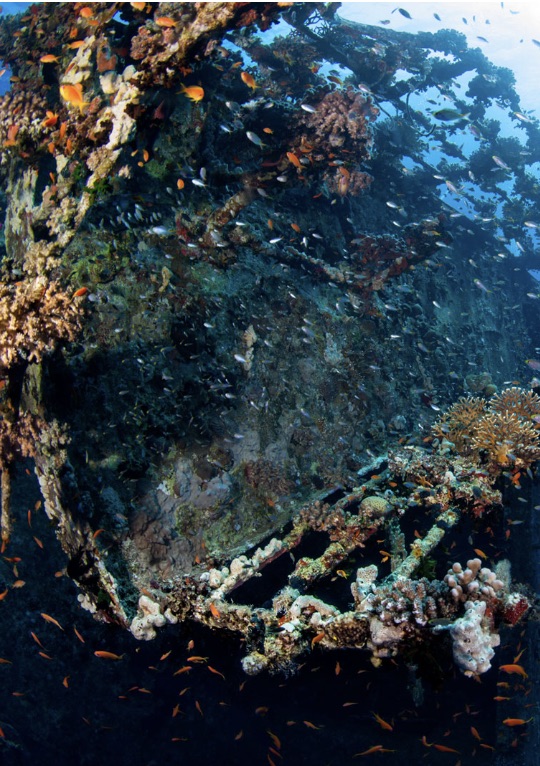
The signature experience of Marsa Alam diving is the shore-entry cave dive. The fringing reef hugs the coast, drops into a shallow lagoon, and the lagoon edge is broken up by cuts, swim-throughs, and small chambers carved into the limestone. You walk in from the beach, wade through a sandy channel, drop down at the reef edge, and the dive is essentially a slow lap through the architecture.
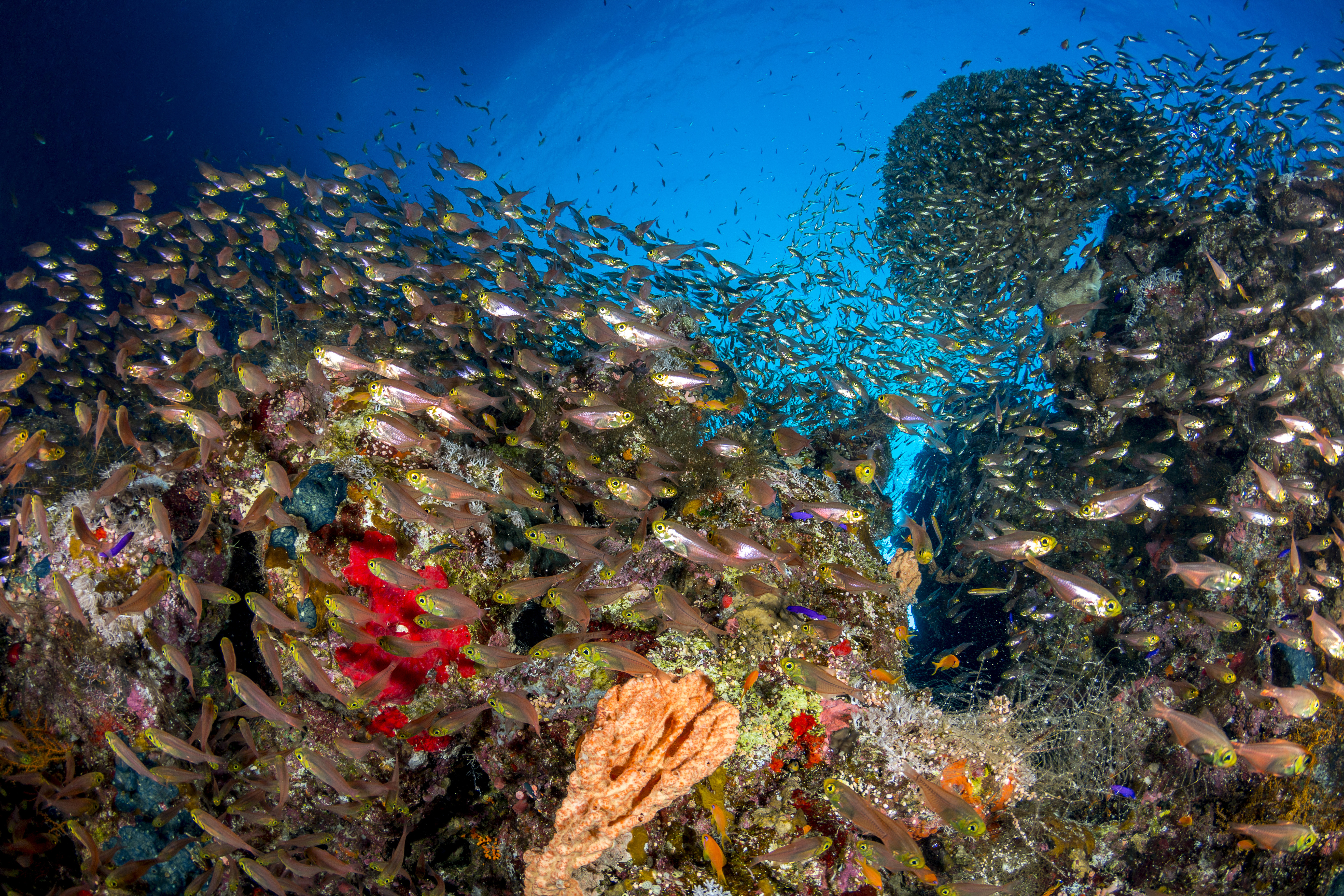
Marsa Shouna, Marsa Egla, the bays around Abu Dabbab. These sites run pattern. A shallow entry of three or four metres over sand, a sloping reef wall down to fifteen or twenty metres, and a series of small cave systems and overhangs cut into the reef where soft corals, glassfish, and sweepers hold the space. You can run the dive shallow and stay among the macro life or work the wall down to the deeper sections where the larger reef fish move.
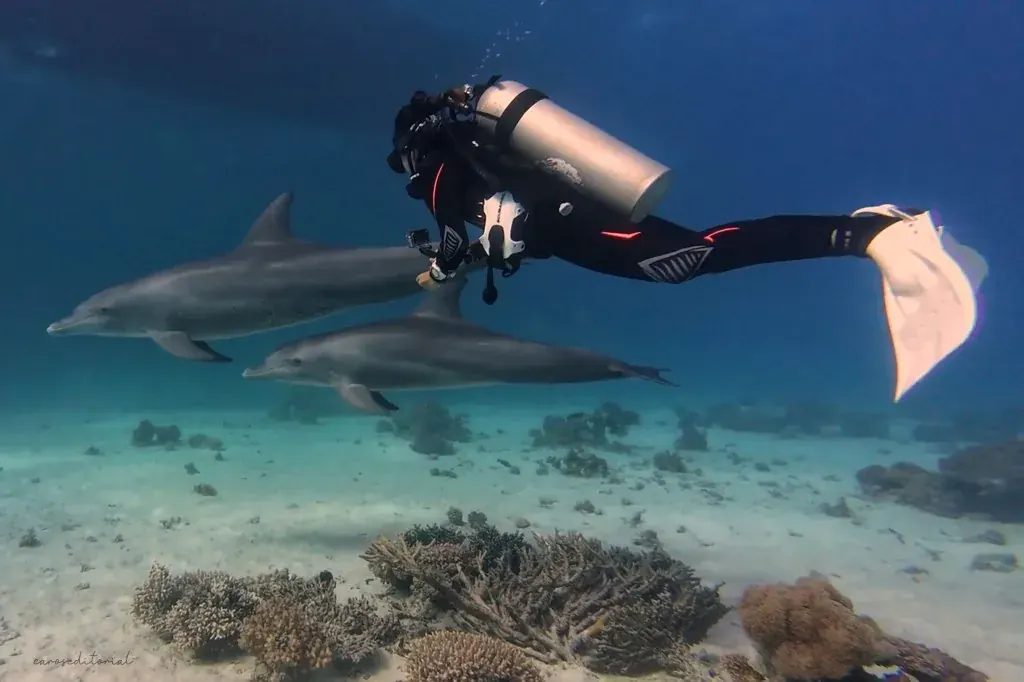
The diving is calm. The entries are easy. The sites are some of the most accessible shore dives in the Red Sea for newer divers and they are also rich enough that a fully kitted technical diver could spend a week on them and not get bored. Octopus, lionfish in numbers, blue-spotted rays in the sand, occasional moray, and the small reef sharks that the southern Red Sea still holds. The hard coral on these sites is in better condition than most of the equivalent shore reefs further north along the Egyptian coast. The southern Red Sea has been treated more carefully, partly because the tourism pressure spread later, and the reef shows it.
Marsa Mubarak and the Dugong
Marsa Mubarak, sometimes written Marsa Mbarak, is the dive that brings most people specifically to this coast. The bay sits just north of Marsa Alam town. The water is shallow, mostly five to twelve metres across the dive site, the bottom is a wide field of seagrass, and a resident dugong lives there.
Dugongs are slow, large, solitary marine mammals that look like a softer, rounder cousin of a manatee. They graze the seagrass meadows the way a cow grazes a field. The Marsa Mubarak dugong has, over the years, become accustomed to divers and snorkellers and tolerates the presence of people who stay back and let it move on its own terms. It is one of the few sites in the world where the encounter is realistic on a single shore dive.
When I dropped in at Marsa Mubarak the bay was busy. Four or five boats above us, a steady drift of snorkellers from the surface, two dive groups in the water at the same time as ours. The dugong was on the eastern side of the seagrass when we found it, grazing, not interested in us at all. Around it the boats had organised themselves into a kind of unofficial perimeter. Snorkellers from above, divers underneath, and the animal in the middle continuing to eat as if nothing was happening.
That was the moment that struck me, more than the dugong itself. A wild marine mammal at the centre of a wheel of people, eating a meal that it had to eat to live, and tolerating the audience because it had no choice. Marsa Mubarak runs the line between accessible wildlife encounter and crowded site, and the dugong’s tolerance is doing more of the work than any guide or rule.
The turtles at Marsa Mubarak are the easier story. Green turtles, mostly, grazing the same seagrass beds as the dugong, and far less bothered by the crowds. On the dive we logged at least eight turtles before we worked our way back to shore. That part of the site is unambiguous. The seagrass meadows here are extraordinarily productive, and the broader role seagrass plays in the ocean carbon and nursery system is the reason Marsa Mubarak still has what it has.
Daedalus Reef
Daedalus is the long ride. About 80 kilometres east of the Egyptian coast, in fully open water, it is a single reef rising from deep water with a small lighthouse on top and no land in sight in any direction. You do not reach Daedalus on a day boat. You reach it on a liveaboard, usually as part of a southern Red Sea itinerary that runs the offshore reefs over the course of a week.
I dived Daedalus and did not see the hammerheads.
That is the version of the story most trip reports leave out, so it is the version I want to lead with. The north plateau is the famous part of the reef. In summer, scalloped hammerheads are supposed to school here in numbers that compete with anywhere in the Indian Ocean. You drop deep, sit at around 25 to 30 metres on the edge of the plateau, watch the blue, and on a good day the hammerheads come up the wall and pass over in formation. On the days I was there they did not. We dropped, we sat, we watched the blue, and the blue stayed blue. A few jacks, a couple of reef sharks at distance, the wall behind us. No hammerheads. No schooling pelagics of any kind.
Some divers on the same boat had seen them earlier in the week. By the time my run came around, the window had closed. That is Daedalus. The reputation is real, the reputation is also a probability, and the probability is not what the marketing implies.
The south end of Daedalus is anemone city, and this part delivers. A field of magnificent anemones running across the slope, packed so densely that the reef itself disappears under the carpet of tentacles. Clownfish in numbers that do not look real. It is one of the most photographable dive sites in the Red Sea and the dive I would put on a Daedalus highlight reel if I were honest about what I actually saw.
The wall on the east side of Daedalus runs vertical from the reef top to past recreational limits. The reef itself is in excellent condition. Hard coral cover that you do not see further north on the Egyptian coast, sponges, soft coral fields, and a structure built up over generations of low-impact diving. The reef is the thing. The pelagic action that the reef is famous for is a bonus when it happens and an absence when it does not.
The diving is current-driven, the entries and exits are timed off the conditions, and the trip is unambiguously for divers with the dives to handle it. Advanced Open Water with a comfortable run of deep and current experience is the minimum, and most liveaboard operators will quietly enforce more. Go for the reef, go for the chance at the hammerheads, do not go assuming the chance is a near-certainty. Anyone telling you otherwise is selling something.
The Reef I Did Not Dive
Elphinstone sits closer to shore than Daedalus, maybe 12 kilometres off the coast east of Marsa Abu Dabbab. It is reachable on a long day boat. The reef is a single offshore pinnacle, oval in shape, with the famous north and south plateaus and a vertical wall down each side.
Elphinstone is the most reliable oceanic whitetip dive in the Red Sea. October through December the whitetips circle the offshore reefs and Elphinstone holds them more consistently than anywhere else on the Egyptian coast. Hammerheads are possible. Thresher sharks have been logged. The current is strong, the depth is real, the dive is one of the named bucket-list dives of Red Sea diving.
I did not dive it. Conditions in the window I had were not safe to run the boats, and a few days I had planned for Elphinstone went to local sites instead. That is the diving in this region in microcosm. The offshore reefs are weather-dependent. Day boat trips to Elphinstone are cancelled regularly. A liveaboard timed around the reef gives you the best odds, a day-boat plan from a Marsa Alam resort gives you the rougher odds. If Elphinstone is the reason for the trip, build the itinerary around a liveaboard and a flexible window.
The piece I will write about Elphinstone will come when I have dived it. Until then, the honest version is that I missed it on this run, and the marketing image of every Marsa Alam trip includes oceanic whitetips that not every diver who comes here is going to see.
The Honest Read on Big Fish
I logged a lot of dives on this coast and saw almost no pelagics. That is the headline. The shore-entry sites are macro and reef. The offshore reef I reached did not produce. Elphinstone did not run. Across the whole trip the count of large sharks I saw is in single digits, the count of hammerheads is zero, and the count of oceanic whitetips is zero.
That is not because the trip went badly. The local diving was strong. The dugong at Marsa Mubarak was real. The reef condition at Daedalus was some of the best I have dived. The trip delivered what it actually delivers when you remove the brochure expectations.
The brochure expectation, that you come to the Egyptian Red Sea and see schooling hammerheads and circling whitetips in the same week, is the part that is not reliable. The schooling pelagic action in the Egyptian Red Sea is an offshore phenomenon, it is seasonal, it is weather-dependent, and it is luck-dependent on top of that. The shore-entry sites do not get the big fish at all. The offshore reefs get them sometimes. “Sometimes” is the honest word and brochures rarely use it.
The local sites have what they have. Octopus, lionfish, glassfish, blue-spotted rays, an occasional small reef shark passing through, plenty of turtles, sometimes a guitarfish on the sand. That is good diving in its own right and the southern Red Sea is among the better stretches of fringing reef on the Indian Ocean basin. It is not the pelagic experience that the wider Red Sea is marketed as.
Come for the reef, the architecture, the dugong, and the long boat ride to a remote site. If those are the reasons you book, the trip lives up to the bill. Come for the hammerheads and the whitetips, and the trip might deliver them or might not. Plenty of divers leave Marsa Alam without seeing the species they came for. I am one of them, and I am writing about it instead of pretending otherwise.
The Coast Beyond the Diving
The road south of Marsa Alam runs into thinning resort development and eventually opens into desert. The road north runs to El Quseir and eventually to Hurghada. Most diving trips here are run out of one of the resorts on the strip between Port Ghalib and Wadi Lahami. Marsa Shagra and Wadi Gimal are two of the older dive bases on the southern coast, both of them oriented around shore diving and run as serious diving operations rather than full resorts.
The Egyptian Red Sea has spent decades absorbing the tourism economy that funds it, and the conservation picture is mixed. The southern Red Sea reefs are in better shape than the central and northern coast around Hurghada. They are also under steady pressure from the resort developments running south along the coast and from the boat traffic concentrated on the small set of marquee sites. The wider story of the Egyptian Red Sea reef covers what conservation organisations are doing to hold the line.
The Salem Express
North of Marsa Alam, halfway between Hurghada and the town, lies the Salem Express. The ferry sank in 1991 with hundreds of pilgrims aboard, most of them never recovered, and the wreck sits in 30 metres of water with the cars, suitcases, and personal effects of the passengers still inside the hull. It is one of the most loaded dive sites in the Red Sea and the ethics of diving it are not simple. The full piece on what diving the Salem Express is like and why I would not recommend the penetration is at the dive guide on the Salem Express wreck here.
Practical Notes
Diving runs year-round. The peak hammerhead window at Daedalus is June through August. The peak oceanic whitetip window on the offshore reefs is October through December. Water temperature drops to around 22 degrees in January and February and a 5mm wetsuit is the working baseline for winter diving. Summer is warm enough for 3mm or a shorty on the local sites.
The Marsa Alam International Airport runs charter flights direct from most European hubs. Most resorts on the coast offer airport transfers and dive packages run as part of the stay. For independent divers, EgyptAir runs internal flights from Cairo, or the bus from Hurghada is around four hours down the coast.
For the local sites, almost any operator on the strip can run shore dives and short day boats. For Daedalus, the Brothers, or a serious run at Elphinstone, the answer is a liveaboard out of Port Ghalib or Hurghada. The southern Red Sea liveaboard week is one of the better diving weeks in the Indian Ocean basin when the conditions hold.
Ear infections are a recurring story for divers running multiple dives a day in the Red Sea, and the bay entries with their soft sand and shallow swim-outs can compound it. The piece on the SurfEars 4 Dive Professional ear protection is worth reading if you are planning a multi-week run.
Nitrox is widely available. Most operators rent full kit in reasonable condition. The dive medicine infrastructure on the southern coast is thinner than around Hurghada, and the nearest recompression chamber is in Hurghada itself. Insurance with diving cover is not optional.
For the wider Egyptian Red Sea context, the diving guide to Hurghada and the central Red Sea covers the northern half of this coast and the differences in what you can expect from each end.