The dive briefing on the boat was different from any I had been on before. Our guide that day had been one of the divers who pulled bodies from the Salem Express in December 1991, in the days immediately after she went down. He had been part of the original rescue and recovery team. Thirty-some years later he was still diving the wreck, and now he was about to take us through it.
He talked us through the layout, the entry points, the depth profile. He also talked, briefly and quietly, about what he had seen the first time he went down to her. He was not theatrical about it. He did not need to be. The room got very still and we listened.
I had dived wrecks before. Tropical day-boat wrecks in Thailand. A few off Cozumel. Small fishing vessels intentionally sunk for divers, an old patrol boat, a steel skeleton softened by twenty years of coral. None of those prepared me for what was on the bottom under us.
What Happened
The Salem Express was an Egyptian passenger ferry operating the crossing between Safaga and Jeddah, Saudi Arabia, a route used heavily by pilgrims returning from the Hajj. On the night of 16 December 1991, the ship was carrying somewhere between 600 and 800 passengers and crew when it struck the Hyndman Reef in rough seas approximately five kilometres from the port of Safaga.
The ship sank in less than fifteen minutes. Official casualty figures listed 464 dead; many historians believe the true number was higher, as the passenger manifest was incomplete. Survivors reported chaos: lifeboats that could not be launched in time, crowds on decks that flooded quickly, a darkness that came before anyone could fully comprehend what was happening.
The Salem Express rests today on the reef that sank her, lying on her starboard side at a depth of between 12 and 30 metres, largely intact, open to the sea.
Going In
The descent is the moment the wreck stops being an idea on a briefing board.
She is enormous. That was the first thing that struck me. The wrecks I had dived up to that point were all at the scale of small boats and patrol craft, the kind of compact tropical wrecks you find in Thailand and Cozumel. The Salem Express is a ferry, the size of a building, and the perspective when you drop alongside her hull and the structure simply keeps going in both directions resets your sense of what a wreck dive is. I had to recalibrate in real time.
The entry I will not forget was the stern. We swam in along the open back of the boat, where the loading ramp had been lowered the night she went down, and the geometry was so wrong, the boat lying on her side, the cars rusted into shapes that were no longer cars, the steel softening with three decades of coral. I remember a feeling that was not fear but something close to it. The dive guide moved through the space ahead of us with the particular quietness of someone who had done this dive a thousand times and never stopped feeling it.
Inside, the silt does not need to be disturbed; the sense of being where you should not be does the work on its own.
What Stays With You
There is a pair of shoes on the bottom. A child’s sandal not far from them. A life jacket, still attached to a railing. Suitcases split open, contents long since dispersed by current and time. Personal effects accumulate in the silt of the lower decks, a watch, a prayer bead, a plastic comb, and the reef has grown quietly over all of it, coral softening the edges of what was, on that night in 1991, a catastrophe.
Two things on this dive will stay with me for the rest of my life.
The first was a child’s doll. She was sitting upright on a metal shelf in one of the inner spaces, looking down, almost composed, at the rubble of personal effects scattered across the deck below her. She had survived everything. The water, the years, the divers passing through. Whoever had carried her on board for the Hajj crossing had not survived the night. She had.
The second was a child’s small suitcase. On its side was a sticker, faded but still legible, that read Happy Journey. The same kind of cheerful luggage marker any child anywhere might have stuck on their own bag. I do not know how to write about that suitcase without overstating it, so I will just say what was true, which is that I cried into my mask for the rest of the dive, knowing that whichever child had packed that bag almost certainly never made it off the ship.
I have done a lot of dives. The Salem Express is the most emotional dive of my life by a margin I do not expect anything else to close.
The Question of Whether to Be There
I came up from the dive with a question I have not fully answered. Should we be here at all?
This is not a war wreck where the dead have been recovered and the site formally memorialised. It is an active underwater gravesite. An indeterminate number of the passengers who died in December 1991 remain aboard. For the Egyptian families who lost relatives, this is not a tourist attraction. It is a national grave.
The Egyptian government has not formally closed the site to diving, and the local dive industry maintains a complex relationship with it. The wreck is significant both as a dive destination and as a place of grief. Debate continues about whether recreational diving here is appropriate. I do not think there is a simple answer.
What I do think is that anyone who decides to dive the Salem Express should arrive with the understanding that this is what they are visiting. Not a wreck. A grave. The way you behave on the boat before, the way you move through the wreck, the way you talk about it afterwards, all of that is part of the dive, and it is part of the responsibility of being there.
Our guide, the man who had pulled bodies from this same vessel as a young diver, modelled what that looks like. Quiet, reverent, no photography in the wrong places, no swimming over personal effects, no story-telling for show. By the time we surfaced none of us were saying much. The boat ride back to Safaga was almost silent.
The Dive Itself
For divers who are choosing to do it, the technical specifics:
The ship lies in remarkably shallow water. The top of the hull sits at around 12 metres, and the deepest accessible sections touch 30 metres, depths accessible to recreational divers with moderate experience. The shallowness and the clarity of the Red Sea water mean visibility is frequently extraordinary: on a good day you can see the full length of the ship from above.
She lies on her starboard side, so the geometry is disorienting at first. The port side, now uppermost, runs along the top of the wreck. Entry points, windows, doors, the loading ramps at the bow, are all accessible without technical equipment. Penetration of the interior is possible at several points, though the silt is easily disturbed and torch beams can vanish quickly in the murk of the deeper internal spaces.
The bow is the most visited section. The loading ramp lies open, still lowered as it was the night the ship struck the reef, and the cars that were loaded in Jeddah remain inside, rusted into shapes that are barely recognisable as vehicles. The ship’s superstructure is heavily colonised by soft corals and sea fans, the Red Sea’s characteristic reds and yellows, and the contrast between the marine growth and the still-identifiable human objects of the wreck creates an effect difficult to describe adequately.
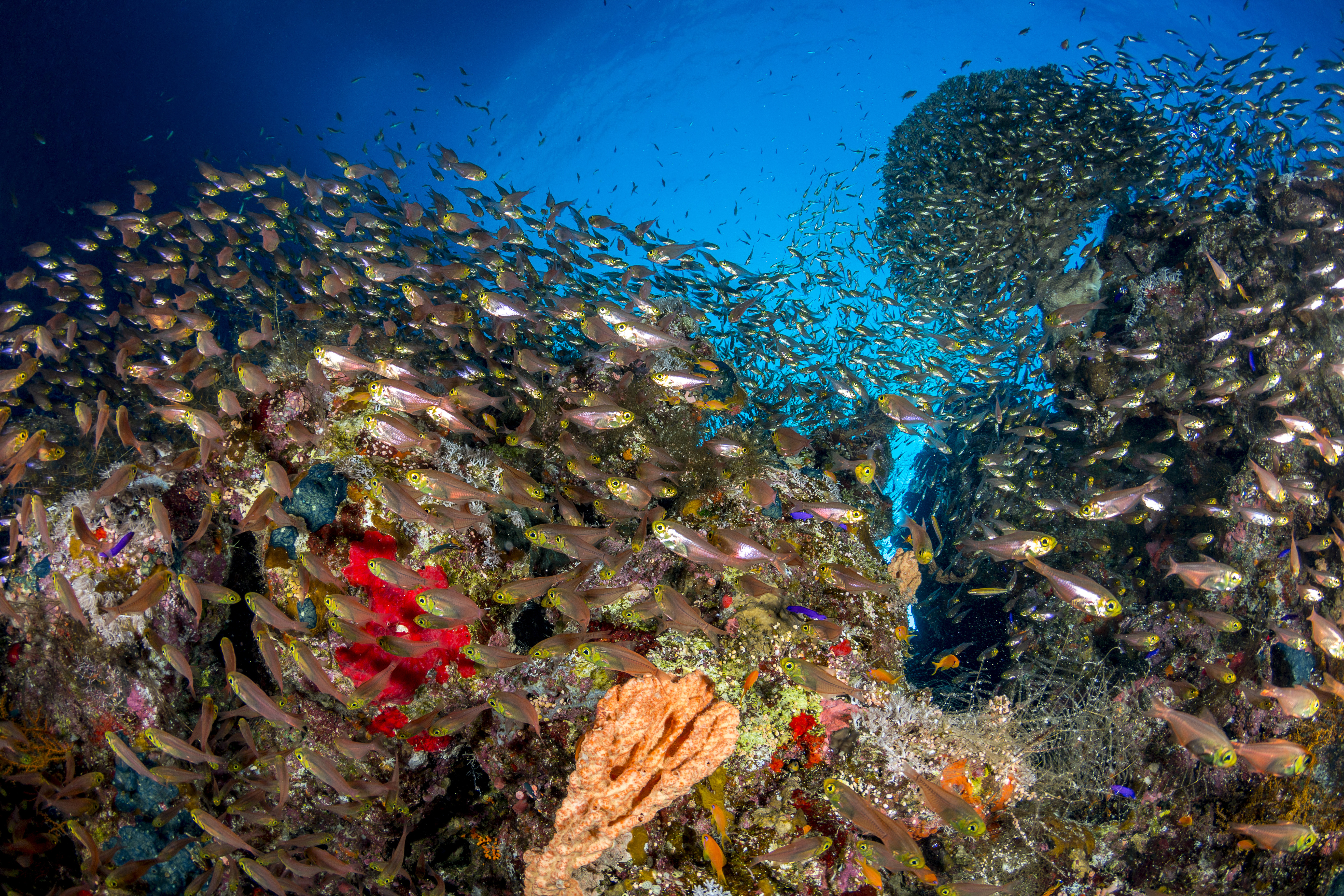
Lionfish have colonised the interior. Glassfish move in clouds through the larger internal spaces. The hull supports a dense reef ecosystem. Life, as it tends to, has made itself at home in the wreck.
The Wider Marsa Alam Region
Marsa Alam itself is one of the Red Sea’s less developed resort towns, situated about 200 kilometres south of Hurghada along the Egyptian coast. The relative lack of development compared to the more crowded northern resorts has preserved both the coastline and the marine environment.
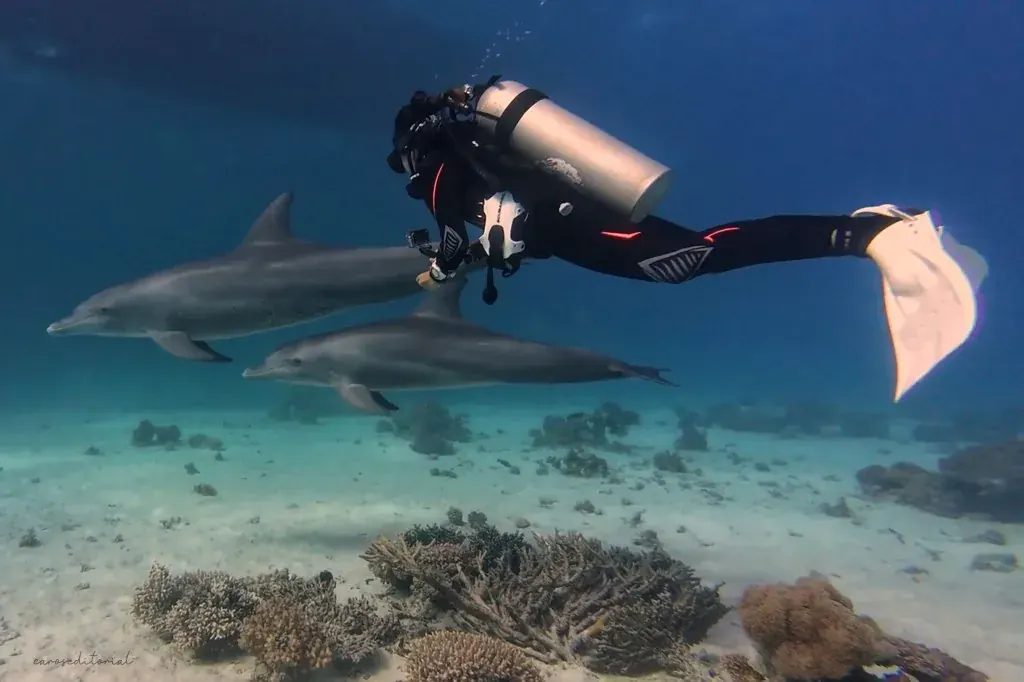
The reefs around Marsa Alam are among the healthiest remaining in the Egyptian Red Sea, a system now under formal government protection that recognises its unusual resilience to climate-driven bleaching. Abu Dabbab is one of the best sites for dugong in the region, with animals regularly grazing the seagrass beds in the shallows. Elphinstone Reef, roughly 25 kilometres north of Marsa Alam, is a deep oceanic plateau famous for oceanic whitetip sharks and the possibility of manta rays. Shaab Samadai, Dolphin House, is a protected lagoon where a resident pod of spinner dolphins rests during the day.
The Salem Express is the most significant dive in the region, but it sits within a broader diving environment of considerable quality.
Practical Notes
The Salem Express is typically dived as a day trip from operators based in Safaga, roughly 45 minutes north of Marsa Alam, or from Marsa Alam itself. Most operators include it as part of a multi-site day trip. Advanced Open Water certification is generally required; the wreck’s maximum recreational depth and the optional penetration dives make this appropriate.
Water temperature in the Red Sea ranges from around 22 degrees in winter to 30 degrees in summer. Visibility is frequently above 25 metres. The site is diveable year-round, with summer offering the warmest water and winter bringing occasional stronger winds that can affect sea conditions.
If you can find an operator with a guide who has a real connection to the wreck, the kind ours did, take that operator. The dive is fundamentally different when you are guided by someone who understands what they are taking you into.
This is a dive worth doing once, slowly, and in silence.