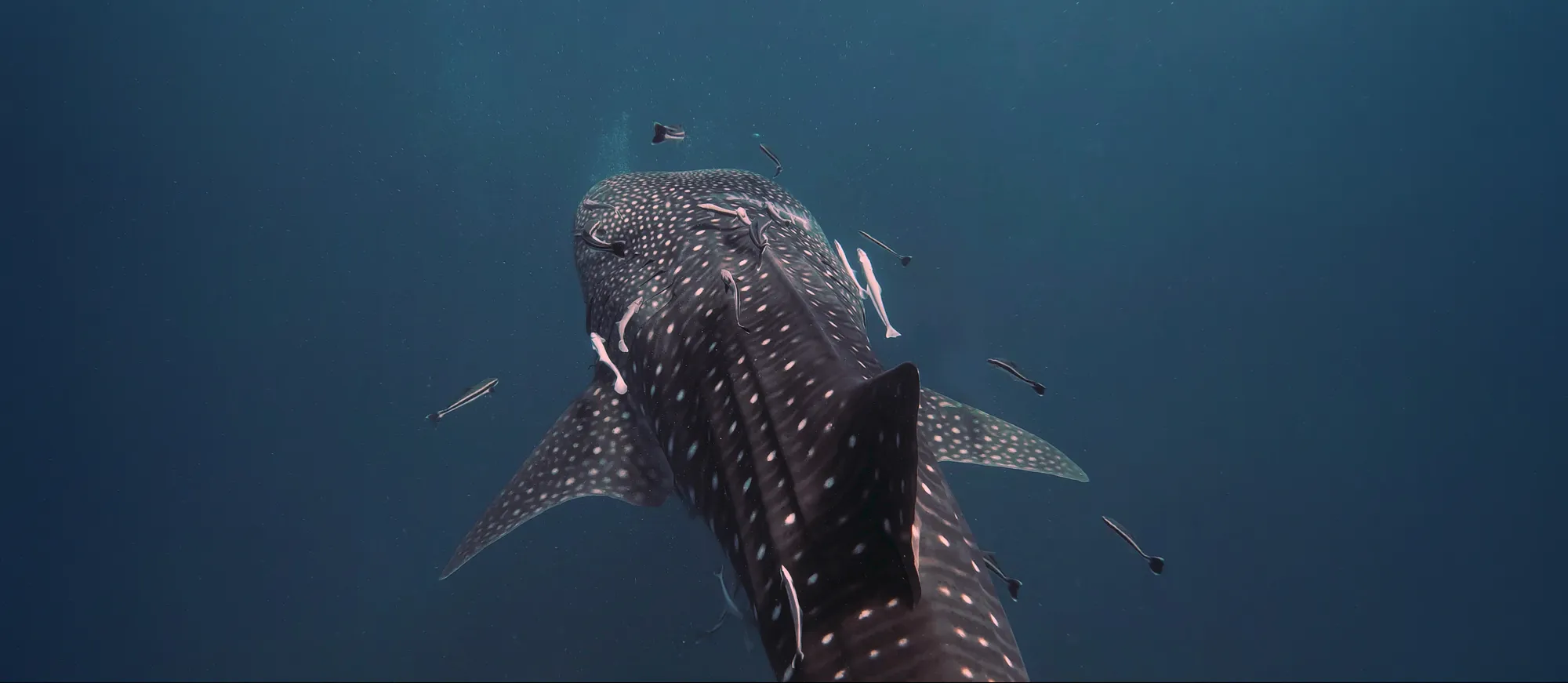
It appeared from below. One moment there was open blue water, and then there was something vast moving through it, resolving slowly into the unmistakable silhouette of a whale shark: the wide flat head, the white-spotted grey body, the long scythe of the tail pushing it forward at a pace that looked leisurely and covered ground quickly.
I was at around 18 metres on Chumphon Pinnacle, one of Koh Tao’s best open-water sites, and I had been waiting for this for three days.
Why Koh Tao for Whale Sharks
Koh Tao’s whale shark reliability is not an accident of geography.
Currents and Pinnacles
The Gulf of Thailand sits between the South China Sea and the deeper waters off the Malay Peninsula, and the Chumphon Archipelago is positioned along a corridor of seasonal upwelling currents that concentrate plankton through the water column. The pinnacles north and south of Koh Tao rise from depths of 35 to 40 metres to within 15 metres of the surface, intersecting that current layer at exactly the depth that puts the food where filter feeders can access it. Whale sharks follow the food. The pinnacles deliver it. What is in that food matters as much as where it sits: across their range, a large share of what these filter feeders are actually eating is krill, the small crustacean that turns plankton into something big enough to be worth swimming for.
The Juvenile Habitat Hypothesis
Most of the whale sharks encountered around Koh Tao are juveniles, animals between four and eight metres long rather than the twelve-metre maximums the species reaches elsewhere. Marine biologists studying populations across the Indo-Pacific have proposed that the Gulf of Thailand and similar sites may function as developmental habitat: places where young whale sharks feed and grow before joining adult populations along the open coast or further afield. The pattern is consistent with what divers see. Six-metre animals are the norm at Koh Tao. Larger animals appear, but not often.
Where: The Pinnacles
Whale sharks in Koh Tao are most reliably encountered at the deeper, current-exposed pinnacle sites.
Chumphon Pinnacle
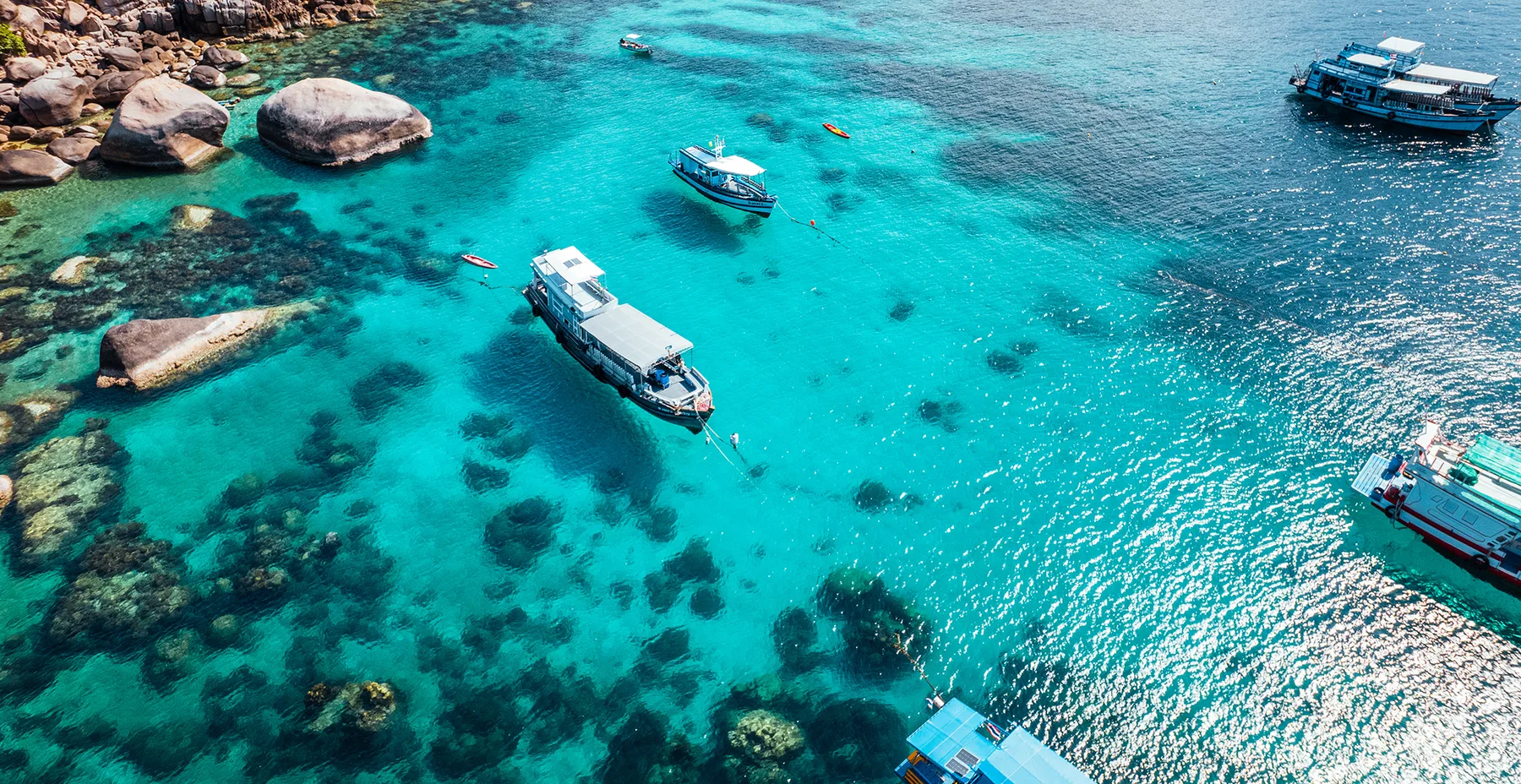
The top site. Rising from 36 metres to around 14 metres below the surface, it attracts schooling chevron barracuda, giant trevally, and periodic whale shark passes. The current can be strong; this is a dive for those comfortable with some drift. An hour boat ride north of Koh Tao in fully open water, which is part of why it stays as productive as it does.
Sail Rock
Sits between Koh Tao and Koh Phangan, about an hour south of the island. A vertical chimney runs through the pinnacle from 5 to 18 metres. Whale sharks are seen here regularly, especially between March and May and again from October through December. The site also holds some of the densest schooling fish life in the Gulf, fusiliers walling the column, batfish, big groupers, which means even a whale-sharkless day at Sail Rock is rarely a quiet one.
Southwest Pinnacle
Shallower than Chumphon and slightly more protected, which makes it a good alternative when conditions are rough elsewhere. Whale shark sightings here tend to be more occasional but the site is reliably strong for schooling fish life regardless. The schools of fusiliers, snappers, and big-eye trevally that work the slopes are some of the largest on the island.
The Encounter
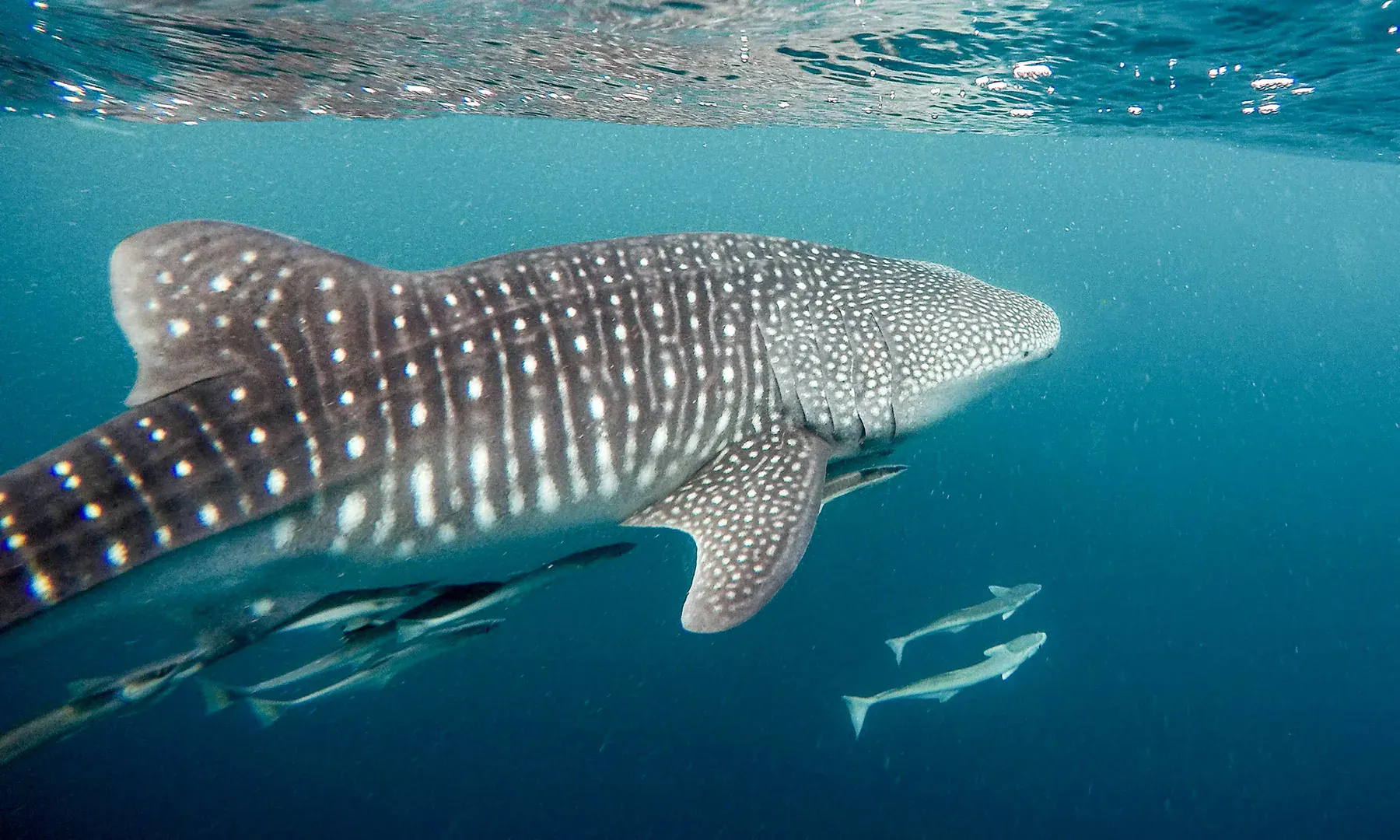
On Chumphon that morning, the shark stayed at around 15 metres for perhaps six minutes before descending back into the blue. It was around six metres long, a juvenile by whale shark standards. It paid us no attention whatsoever, which is exactly the right relationship.
What you remember afterward is not the size, though six metres of animal moving past at conversational distance is its own thing. What you remember is how unhurried it was. The pace at which a whale shark moves through water is the most fundamental information about the encounter: nothing about the body language is interested in you, nothing is reactive to you, nothing changes course for you. The dive is happening in their water and they have decided the terms of it.
The Encounter Protocol
The encounter rules exist because whale sharks are wild animals that have not learned to avoid the species causing them the most harm.
What to Do
Stay calm. Slow your breathing. Hold position. Whale sharks are filter feeders that pay no attention to divers, so the encounter is shaped entirely by the diver’s discipline, not the animal’s. If the shark is going to pass close, it will pass close at its own pace. Photograph the left flank if you can: the spot pattern on a whale shark’s left side is what researchers use to identify individuals, and your photo can contribute to the wider population database. More on that below.
What Not to Do
Do not touch. Do not chase. Do not position yourself above or in front of the animal. Do not use a flash. Do not kick hard after it. The same rules, and why the species needs them, are set out in full for International Whale Shark Day. The international research protocol is consistent: at least three metres from the body, four metres from the tail, the animal sets the pace. A diver who chases burns their air faster, frightens the shark away from the site, and ruins the encounter for the divers behind them.
What the Industry Should Be Doing
The reality on a busy day in season is that radio chatter spreads a sighting across the Koh Tao fleet within minutes, and fifty divers can end up in the water around a single animal. Operators running their boats well are tightening this: capping divers in the water at a time, repositioning rather than circling, briefing the protocol before the dive rather than relying on individual judgement in the moment. Choose those operators. The long-term version of these encounters depends on it.
When: The Two Windows
Whale shark sightings in Koh Tao peak in two annual windows.
March to May
The end of the dry northeast monsoon. Calm seas, the warmest surface temperatures of the year, and the east-side sites at their most reliable. This is the window most operators build their season around and the one with the longest run of consistent sightings.
October to December
The shoulder of the southwest monsoon transition, when nutrient-rich currents return to the Gulf after the wet months. Visibility can be more variable, but the feeding conditions concentrate the animals. October sightings tend to coincide with the most active feeding behaviour of the year.
Visibility across the island averages 15 to 20 metres year-round, and water temperature sits between 27 and 30 degrees.
Conservation Status
IUCN Endangered
Whale sharks were reclassified from Vulnerable to Endangered on the IUCN Red List in 2016. Global populations have declined by more than fifty percent in three generations, with the steepest declines in the Indo-Pacific region that includes the Gulf of Thailand. The animals reach sexual maturity slowly, around 25 to 30 years of age, and individuals can live for over a century. That biology is what makes whale shark populations slow to recover from any pressure.
The Pressures
Direct fishing for whale sharks has been banned across most of their range, but the species continues to be caught as bycatch in industrial tuna and gillnet fisheries. Boat strikes are a documented mortality factor in tourist hotspots. Plastic ingestion is recent enough that researchers are still measuring its long-term effect. And the tourism pressure itself, where it is poorly managed, contributes: stressed animals leave sites where they were previously reliable, and the operators that depend on those sightings then push harder on the animals that remain. The broader pressure on shark populations globally is documented in the shark fin trade piece.
The Thai Whale Shark Project
The Thai Whale Shark project has been documenting individual whale sharks across Thailand’s waters since 2017, using photo identification of the spot patterns on each animal’s left flank. The methodology is established, and the global database links Thai sightings to other Indo-Pacific regions, building the population-level picture nobody can construct from a single site. Divers contribute by uploading left-side photographs of any whale shark they encounter. The animal that passed me on Chumphon may be in that database now, identified by a pattern I never thought to photograph properly. That is the part of the encounter that lasts beyond the dive.
Practical Notes
Certification to Advanced Open Water is recommended for the pinnacle sites due to depth and potential current. Most Koh Tao operators will rent full equipment, and Nitrox is widely available and worth considering for multiple-dive days at depth.
Encounters are not guaranteed. Come for the diving, and let the whale shark be the dive you remember the trip by.
For the wider picture of Koh Tao, the dive sites beyond the pinnacles, the training culture, and the reef condition under the fourth global coral bleaching event, see the full Koh Tao destination guide.