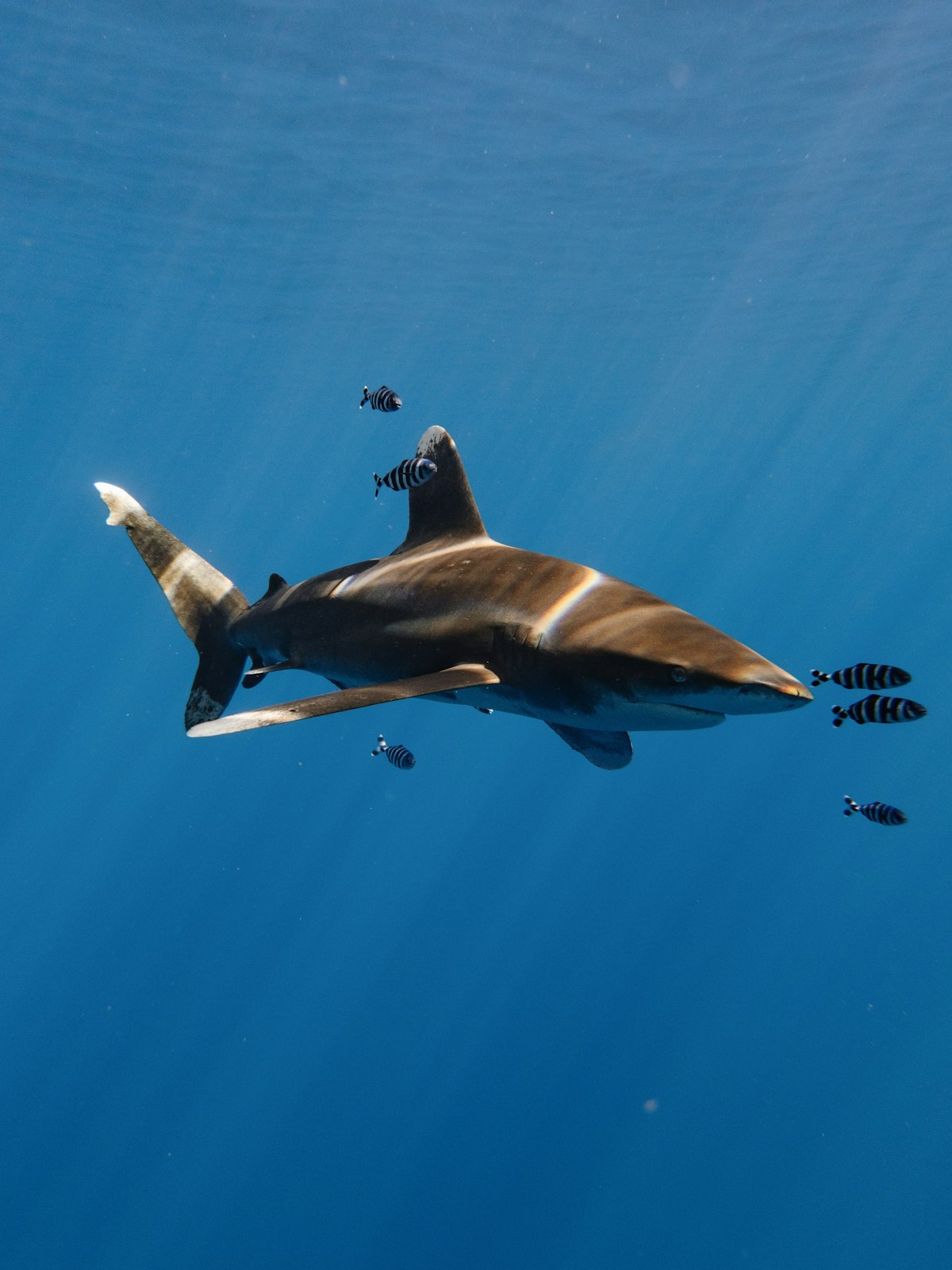
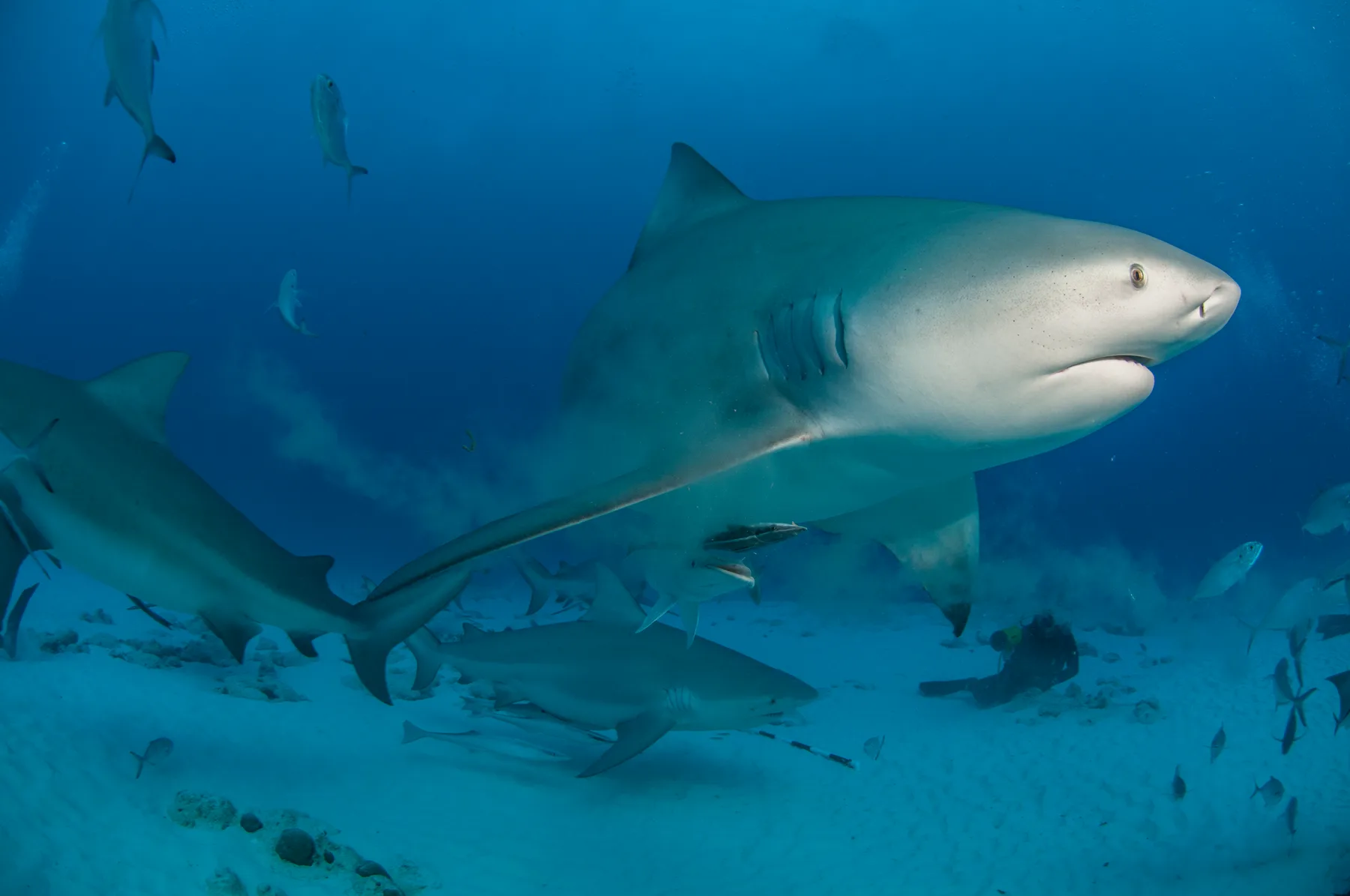
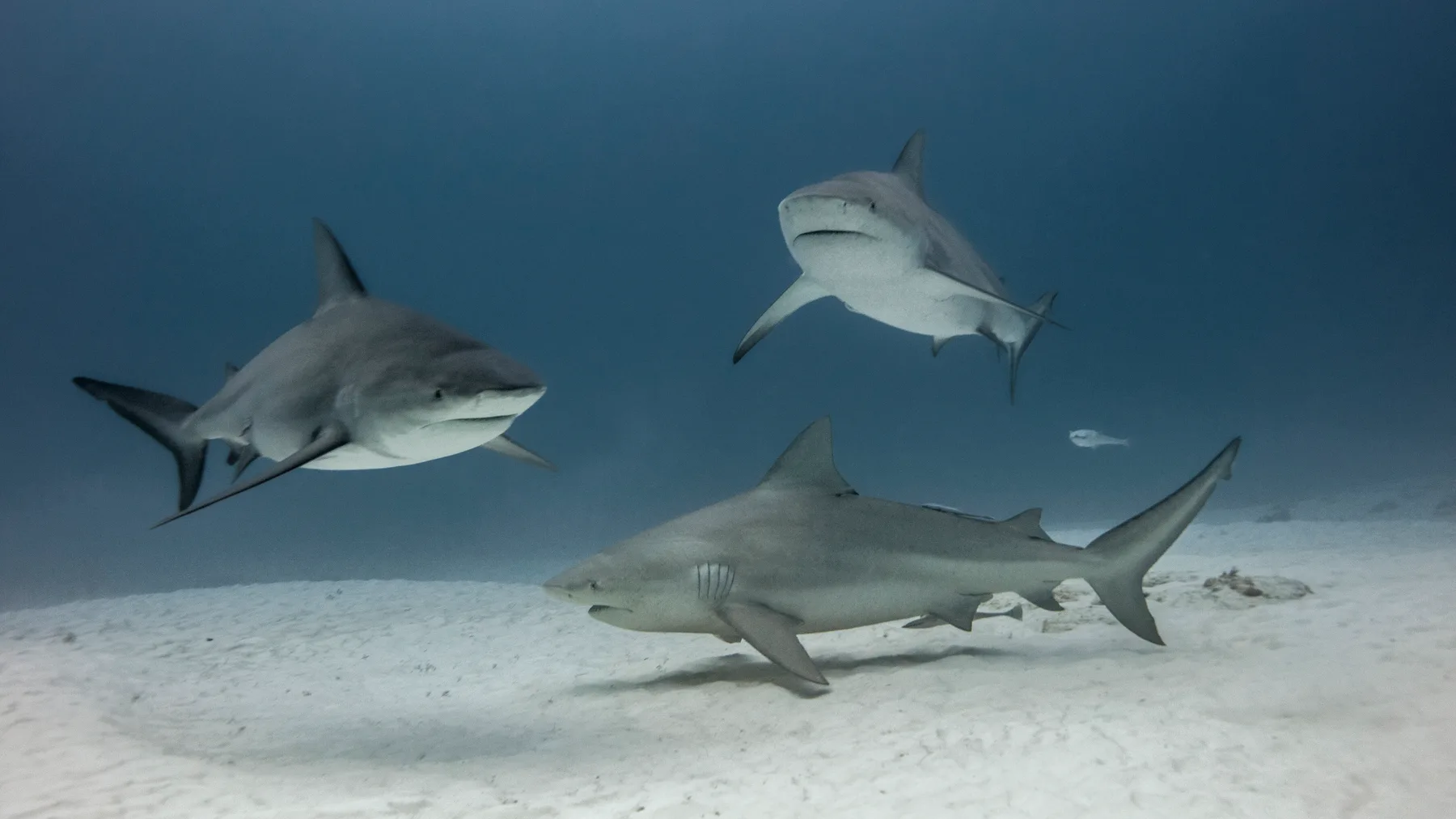
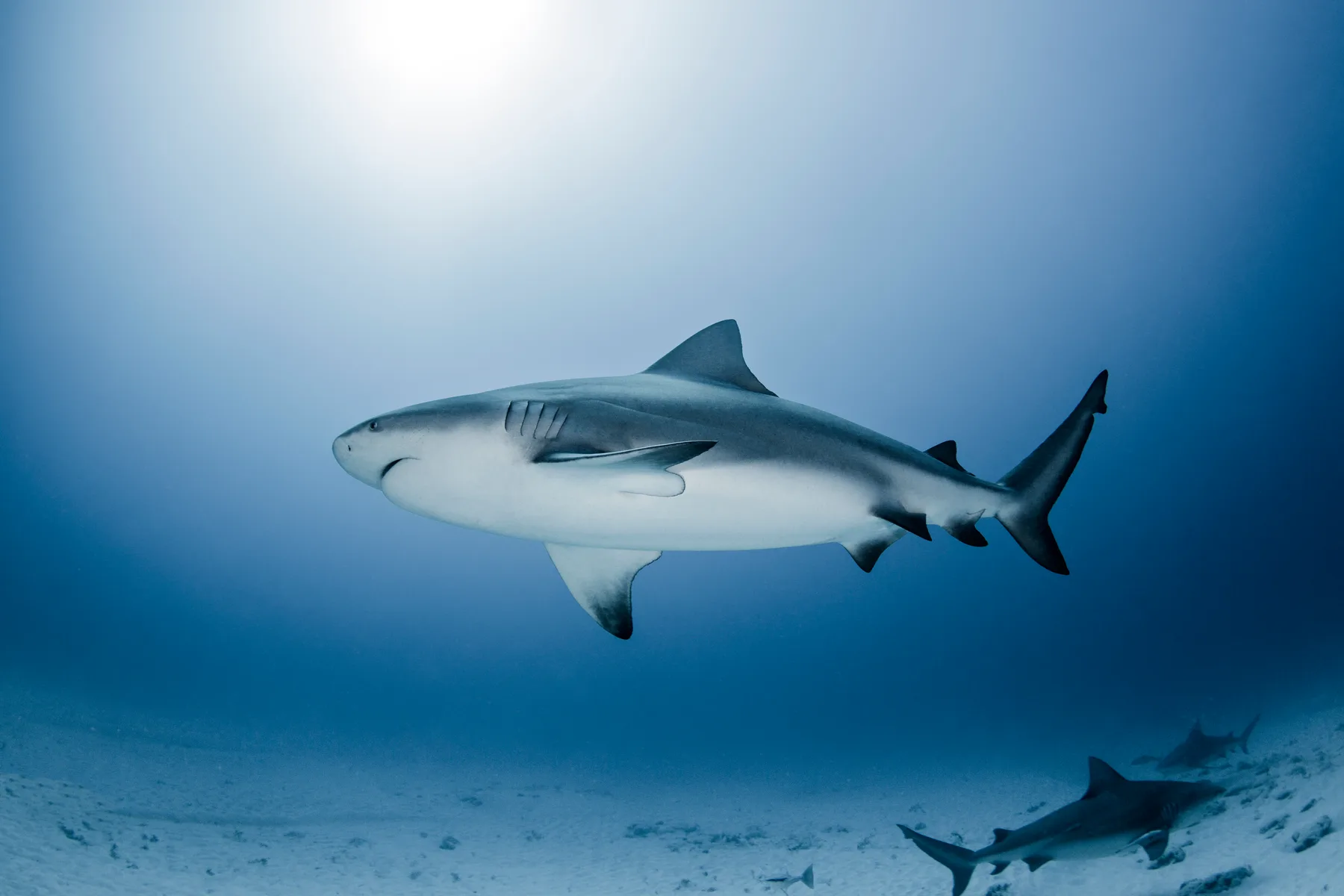
She came over the reef ridge without warning, a large female bull shark, perhaps two and a half metres long, moving with the unhurried directness that characterises her species. The fin first, then the broad blunt snout, then the thick body sliding past at four or five metres. Like a tank coming over a ridge. She paid no attention to me or to the freelancer guide I had hired to dive the site privately that day. She had been doing this every winter for years.
The bull shark dives off Playa del Carmen are one of diving’s more unlikely spectacles. The standard tourist version is a ten-minute boat ride from a beach resort town, a drop to around 20 metres, a line of divers kneeling on a sandy bottom, and the sharks arrive. The version we did was different. A freelancer, just us, the reef instead of the sand pit, and the sharks on their own terms.
I’m a PADI Divemaster and underwater photographer. The notes below are what I learned from diving El Jardin privately, watching how the operator-run version of the dive is set up, and reading the research on what these animals are actually doing here.
Why Bull Sharks Come to Playa del Carmen
The bull sharks are one season on this coast. The rest of the year the diving here is the wider reefs and cenotes of Playa del Carmen, which is a different trip entirely.
Every winter, between November and March, large pregnant female bull sharks gather off the Riviera Maya. The why is still debated. The leading hypothesis is gestational: warm, nutrient-rich water as a final-trimester refuge before the females move offshore to give birth. Whatever the reason, the returns are reliable enough that an entire local dive industry has built itself around them.
The named site is El Jardin. Fifteen to twenty-five metres on a sand floor, visibility most days between twenty and thirty, water temperature in the high twenties even in January. Easy diving by every measure that does not involve the animal arriving from your peripheral vision and not slowing down.
The 2025-2026 season has run consistent with the pattern. The first females showed in late November, the encounter window held through January, and the operators in town are running the trip on the same cadence they’ve run it for the better part of a decade. None of which guarantees a given week, but the aggregation is one of the more dependable big-animal encounters in the recreational diving calendar.
The Dive
The Setup
The standard tourist version of this dive is a ten-minute boat ride from a beach resort town, a drop to around 20 metres, a line of divers kneeling on a sandy bottom, and the sharks arrive. That’s the format that built the local industry around the aggregation, and on most days it works. What it gives up in exchange for reliability is the chance of a wild-context encounter, the kind where the animal arrives because the conditions are right rather than because somebody set a stage.
The version we did was different. A freelance guide, just the two of us, on the reef instead of the sand pit, and out on the water without a group. The freelancer was someone who had been diving the area for years and who knew where the bull sharks were transiting before they arrived at the operator anchor lines. Going private costs more, takes more setup, and removes the safety net of a structured group. The trade is access to the dive on the animals’ terms rather than the industry’s.
The Reef Approach
El Jardin sits at 15 to 25 metres on a sand floor with reef ridges rising at its edges. Visibility most days is between 20 and 30 metres. Water temperature in the high twenties through January, dropping a degree or two in the colder Februaries. The reef along the ridge does what a healthy Mesoamerican reef should do: brain coral and sea fans, snappers in schools, the occasional barracuda tracking the upper water column. A reef dive in its own right before the sharks become the point.
The current matters. On a calm day it is gentle and easy. On a working day it pushes hard along the slope and finning costs you energy. The operators time their drops to the calmer windows, but if you come during a current week, the dive is more demanding than the marketing suggests. Be honest about your buoyancy and your fitness before you book.
The Encounter
She came over the reef ridge without warning. A large female bull shark, perhaps two and a half metres long, moving with the unhurried directness that characterises her species. The fin first, then the broad blunt snout, then the thick body sliding past at four or five metres. Like a tank coming over a ridge. She paid no attention to me or to the guide. She had been doing this every winter for years.
A few more passed in the same window. We tracked them from anchor to anchor on the reef while the current did its work on us. The reef was sitting in real water that day, the kind where finning hard buys you ten seconds of stillness, and watching meant a slow series of compromises between view and grip. The sharks moved through the same water as though it was not there. Two and a half metres of muscle cutting a clean diagonal across the slope while two divers fought for a position to film from.
The Sand Pit
Down on the sand it was different. The current dropped to almost nothing in the lee of the reef, which is part of why operators set up there. We went, we watched, we did not participate. The setup is built for feeders, and that is a problem I’ll return to in its own section below. The version we had just done, on a healthy reef in working current, was the real thing. The sand felt like its echo.
This was also pre-camera-era for me. The footage above came from a DJI Osmo Action 3, fine at the surface, useless for colour by the time you were at twenty-five metres. The bull sharks in the video look more grey-on-grey than they were. The encounter does not depend on the footage, but it is worth knowing what an action camera will and will not give you at that depth before you bring one as your only option.
What to Expect on the Boat & Underwater
The standard operator version of the trip runs to a predictable rhythm and that’s part of why it works.
Pickup is usually from a hotel or a meeting point in central Playa, between 8 and 9 in the morning. The boat ride to the site is short, about ten minutes, and the boat sits on a single mooring line for the duration. Group size varies by operator, from four divers per guide at the better shops to twelve or more on cattle boats. The briefing is meant to cover the dive plan, the descent procedure, the formation on the sand, hand signals, and what to do if a shark approaches close. Briefings under five minutes are a red flag. Real briefings take fifteen.
The descent is a controlled drop on a line. Most operators have you grouped at the surface, then descend together in a line. At depth, divers are arranged in a horizontal row or shallow semicircle on the sand, kneeling on a hard substrate at 18 to 22 metres. The divemaster typically takes a position in front of the line. The instruction is to stay still, breathe slowly, and keep arms in. Bull sharks navigating a group of divers behave very differently when the group is calm than when somebody is finning or flapping.
The encounter window inside the dive is usually 15 to 25 minutes. Two to ten individuals is a typical sighting count. They do not approach in a predictable pattern. Some passes are at five metres of distance, some are within two metres of the line. The ones that come close come close in stages, drifting in along their own trajectory, not investigating you. Looking away briefly while one passes near is normal and recommended. Hard eye contact and abrupt movement read as challenge to a wild predator and that is not the message you want to send.
The dive ends with a controlled ascent on a line and a safety stop. Surface interval back at the boat is typically 45 minutes to an hour while the second dive of the day is set up. Most divers come back up with their adrenaline still on and not many words for the first ten minutes. That is normal.
The Ethics, Bait vs Observation
The bull shark dive at El Jardin exists in two operator formats and the difference between them matters more than any other choice you make about this dive.
The first format is the baited dive. A bait box is set on the sand at the descent point and the dive briefing builds around it. The sharks are reliable, the passes are close, and the divers come up with the footage they wanted. Operators that run this format will not always volunteer it. The marketing language to watch for is “guaranteed encounters” and “feeding demonstrations” and “shark interaction”.
The second format is the observation dive. No bait, no feeding station, no inducement. Divers are positioned on the sand or in the water column where the sharks are known to transit, and the encounter happens or it does not. On a good day the encounters are excellent and the animals come close on their own initiative. On a slow day you log a long, controlled dive at 22 metres in clear water and the sharks pass at distance or not at all. The marketing language is harder to find because it is not as commercially attractive a sell.
The argument against baited dives is operational and ethical at the same time. Operationally, repeated baiting trains wild predators to associate human silhouettes with food. Over a season this changes how the animals behave near divers, near surface swimmers, and near fishing boats. The behavioural change is not theoretical. It has been measured in multiple shark-bait tourism contexts. Ethically, paying to manipulate the behaviour of wild predators for a photograph is a different kind of encounter than meeting them on the ground their own life has chosen.
We are firmly against baited dives at El Jardin. The aggregation is reliable enough that the observation format works. The honest answer your operator gives when you ask whether they bait is the answer that tells you what kind of operation they are. Operators that observe will tell you they observe and explain why. Operators that bait will tell you they do not, or they will reframe it (“we use scent stimulation,” “we drop a small attractant”). Pay attention to the reframing. It is the same dive on the animals.
Choosing an Operator
The bull shark season is short and most reputable shops in Playa run this trip. Picking the right one is less about which operator is famous and more about the questions you ask before you pay.
Group size and ratio. Ask the maximum divers per guide. Four is a working number that lets the guide hold the line and the encounter quality stays high. Eight is the upper limit for any operator that takes the dive seriously. Twelve is a cattle boat and the dive will be a different experience to what you saw in the marketing.
Briefing quality. A good briefing on this dive takes fifteen minutes. It covers the dive plan, the descent procedure, the formation on the sand, what hand signals will be used, the rules for shark approaches, and the abort plan if conditions or sightings demand one. If the briefing is under five minutes, the operator is treating the dive as a routine drop and you are paying for the volume model.
Bait stance, asked directly. Stated above. The answer matters.
Certification minimums they enforce. Open Water is the absolute floor any operator will accept. Advanced Open Water is the recommended minimum because the dive sits at 18 to 25 metres and you want comfortable depth experience. Operators that take Open Water divers to 22 metres on their first dive after certification are running a risk you do not have to accept.
How long they have run the trip. Operators that have run this dive every winter for several seasons read the conditions on the day and adjust. Operators that added it to the menu last year do not have the same local knowledge of where the animals transit on a given current.
Local language match. If you do not speak Spanish and the briefing is in Spanish, that is a problem. Most Playa operators run briefings in English on request. Ask before booking.
The bull shark dive is one of the more accessible big-animal encounters in scuba, and the entry barrier is low. The differentiator between trips is not whether the operator can put you in front of the sharks. It is how they run the part of the dive between getting on the boat and getting off it.
What to Bring
Bring your own mask if you have one. Rental masks in any dive town fit no one perfectly, and a sub-optimal seal on a dive that puts you 20 metres from the surface with a wild predator in the water column is a small distraction that will keep being a small distraction for the whole dive.
Bring your own dive computer if you have one. The bull shark dive is run as a no-decompression recreational profile and the computer is the simplest way to manage your own ascent rate and surface interval honestly. Operators will rent one and the math will be the same, but a familiar interface is a meaningful comfort on a dive where you would rather not be re-learning a stranger’s screen.
Bring a 3mm full-length wetsuit for the November to March season. Water temperature ranges from 26 to 28 degrees Celsius in those months. A shorty is workable on the warmer end. A 5mm is overkill unless you chill quickly. Rental is widely available and the suits are in reasonable condition.
Camera gear is the choice that creates the most regret in either direction. A compact action camera is enough to capture a bull shark passing at four metres, and at the price point of an Osmo or a GoPro it is the right tool for most divers’ first time on the site. The honest limitation is colour. The footage above was shot on a DJI Osmo Action 3 at 22 metres without artificial light, and at that depth blue swallows almost everything else. The encounter is in the file. The footage looks more grey-on-grey than the dive was.
A proper underwater photography rig with strobes is the next step up if photographing wildlife at depth is something you are going to keep doing. It is not the right tool for a one-time trip. The setup cost is real and the learning curve is real, and a wrong-button moment in front of a bull shark is more memorable than the photo would have been.
Whatever you bring, dial in the settings before you descend. Fiddling with a camera on the line with a shark passing four metres away is the easiest way to miss the encounter you came for.
Logistics
Most operators run the bull shark dive as a two-tank day. The bull shark dive sits in the morning slot and a second dive, either a reef site closer to Playa or a cenote inland, fills the afternoon. The afternoon site varies by what conditions and your certification level support.
The season is November through March. December, January, and February are the strongest months for both number of animals and consistency of sightings. November and March are the shoulders. Outside this window, the animals are not in residence and the operators run other trips.
Tulum to Playa is a 45-minute drive south and operators do collect from Tulum for the trip. The dive is logistically the same; you start your day earlier. Cozumel divers should know that the bull shark dive does not run from Cozumel directly; the trip launches from Playa and a Cozumel-based diver needs the morning ferry across.
Beyond the Bull Sharks
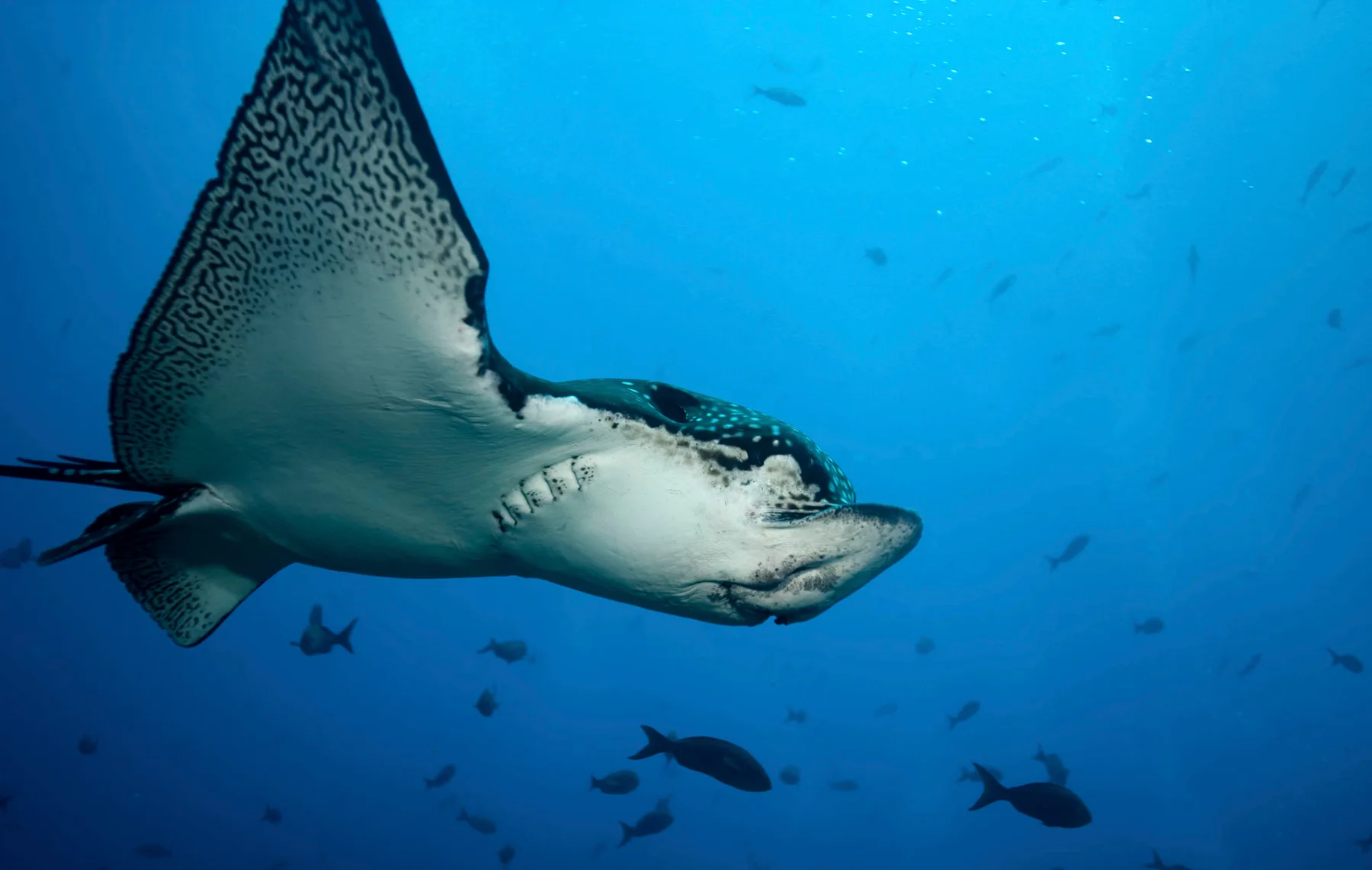
The bull sharks are why most divers come, but the coast does not run dry the rest of the year. Playa sits at the top of the Mesoamerican Barrier Reef, the second-longest coral system in the world, and the reef along this stretch does what a reef should do. Nurse sharks tucked under ledges year-round. Turtles cruising the slopes as a baseline expectation rather than a highlight. Southern wall sites that drop past recreational limits, with the coral architecture and schooling fish life you would hope for in a system whose marine protections have held in place.
The cenotes are the other thing. The inland sinkholes that riddle the Yucatán are a different kind of diving entirely: cold, crystal-clear freshwater pooling on top of denser salt, the haloclines bending the light into shapes you do not see anywhere else. The named sites worth booking include The Pit (also called Cenote Azul) for the halocline at twelve metres and the hydrogen sulphide cloud below it, Taj Mahal for its flooded cave chambers at recreational depth, and Angelita for the suspended sulphide layer that looks like a dark underwater river. A trip to Playa that does not include at least one cenote dive is half a trip.
A Note on the Animals
Bull sharks carry a reputation. Some of it earned: they push into brackish and freshwater systems where encounters with people are more likely, and they can be aggressive when stressed or provoked. The reputation has also helped make them a target of the shark fin trade alongside species more obviously commercial. None of that reputation tracks with what an open-water dive at El Jardin looks like. The animals there move through divers the way you move through a hallway.
They are not tame. They are wild predators who have chosen, for reasons of their own, to spend their winters in a stretch of ocean that happens to be convenient for humans to dive. The right response is what it is for any large wild animal: respect, stillness, attention. The reward is one of the more honest encounters with apex marine life still available to a person who can sign up on a Tuesday and be in the water by Thursday.