Eleven thousand sharks per hour. Read that number again, slowly. It is the widely cited estimate for the rate at which sharks are killed to supply the global fin trade, fins dried, shipped, and sold primarily for shark fin soup across China, Hong Kong, and the Chinese diaspora. The number has appeared in conservation literature for years, which can give the impression that it is old news. It is not. Eleven thousand per hour is still happening, this hour, the next one, the one after that.
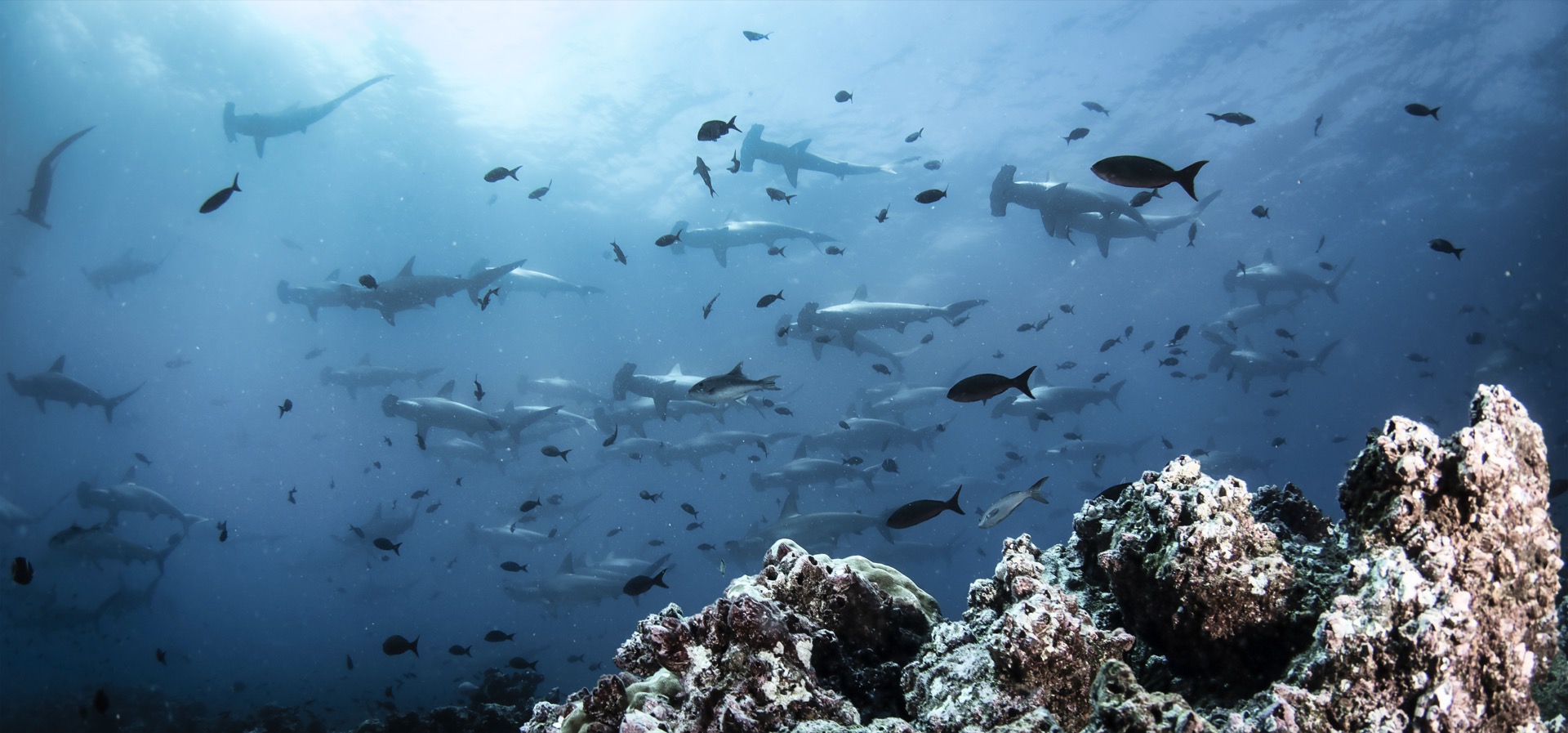
I have dived enough places around the world to know what a healthy reef ecosystem feels like, and to recognise the absence when it is missing. Three months of diving in the Red Sea, two shark sightings. Locals there talked about post-COVID overfishing as the cause. The pattern repeats across most of the diving I have done. The exceptions are the places where somebody is actively defending the water. In Colombia, three sites still produce sharks and pelagics in numbers a working reef should: Isla Providencia in the Caribbean, and Gorgona and Malpelo on the Pacific. And Malpelo only because the Fundación Malpelo and the small permanent crew on the island spend their working lives keeping illegal Chinese fishing vessels off the seamount.
Why Sharks Matter More Than Most People Realise
Sharks are apex predators, which means they regulate everything below them in the food chain. Remove the apex, and the cascade begins. Mid-level predators, snappers, groupers, jacks, become more numerous and less controlled. Their prey, herbivorous fish, invertebrates, declines. Without herbivores, algae grows unchecked on coral. Algae shades and smothers coral polyps. The reef degrades.
This sequence is not theoretical. A 2021 study published in Nature Research surveyed nearly 400 reef sites across 58 countries and found that reef sharks were functionally absent from nearly 20% of them. Functionally absent means not a single shark observed across multiple survey dives, a biological silence that would have been inconceivable on a healthy reef fifty years ago.
The same study found that shark depletion was strongly correlated with human pressure: proximity to markets, weak governance, low-income fisheries with limited alternative livelihoods. In other words, the reefs losing their sharks are the reefs least equipped to lose them.
The Fin Trade in 2026
Bans exist. The United States banned the sale of shark fins in 2011, and most EU member states followed. CITES Appendix II listings now cover around 30 shark and ray species, requiring export permits that theoretically ensure trade is sustainable and legal. Hong Kong, the world’s largest fin trading hub, has seen fin imports drop by an estimated 80% since 2012, driven by a combination of international campaigns and declining demand among younger consumers.
But the trade persists, and the volume remains enormous. A 2023 study in Current Biology analysed global fishing records and found that the species most traded in fin markets, blue sharks, silky sharks, oceanic whitetip sharks, are being caught at rates that exceed sustainable levels on every major ocean basin. The legal trade provides cover for illegal, unreported, and unregulated fishing. Fins are small, high-value, and easily concealed.
The geography has shifted too. As scrutiny of Hong Kong markets increased, trading moved toward smaller regional hubs: parts of Southeast Asia, West Africa, South America. In Colombia, artisanal fishing communities have traditionally been outside the reach of enforcement. The regulations exist on paper. The capacity to enforce them at sea does not always follow.
Manta Rays and the Broader Picture
Manta rays are not sharks, but they share the same threat. Their gill plates are sold in traditional Chinese medicine markets as a blood purifier, a use with no clinical evidence base. Manta rays are slow to reproduce: a single pup per pregnancy, every two to three years. Their populations cannot recover quickly from targeted fishing.
I spent three days last year diving with a resident manta population off the Rosario Islands. There were eleven individuals the dive guides could identify by name, by their belly markings, which are as individual as fingerprints. They knew each one’s approximate age, movements, pregnancy history. Eleven mantas, known by name, in waters that should hold hundreds.
The Manta Trust estimates that global manta populations have declined by more than 30% in three generations. Both manta ray species are listed as Vulnerable on the IUCN Red List. In 2013, they were added to CITES Appendix II. In practice, enforcement varies so widely that the listing provides different levels of protection depending almost entirely on which flag the fishing vessel is flying.
What Divers Can Do
The most direct action is economic. Refusing to eat shark fin soup, and making that refusal visible and explained, removes demand from the chain. Campaigns in China and Hong Kong targeting status consumption, which is the primary driver of fin demand, have been more effective than most conservation advocates expected. Younger urban consumers are moving away from the dish. Social pressure works faster than legislation.
For divers, the Shark Trust’s Great Eggcase Hunt and the iNaturalist shark sighting network contribute to population monitoring databases that inform stock assessments and CITES listing decisions. Shark sighting data submitted by recreational divers has materially changed what scientists understand about distribution and abundance in under-surveyed regions.
Choosing dive operators who refuse to take guests to shark feeding sites, who brief on fin-first buoyancy, and who report illegal fishing to national authorities is not a small thing. Advocating for marine protected areas and the communities that enforce them is the most structural action available to divers. Dive tourism generates an estimated USD 314 million annually in reef shark-related revenue, more, per shark, per year, alive and swimming, than the global fin trade generates dead.
The maths has been done. A reef shark is worth approximately USD 73 per dive encounter, roughly USD 1.9 million over its lifetime. The fin of the same shark is worth around USD 108. Alive, that shark is worth eighteen thousand times more to the dive economy than it is dead.
Eleven thousand per hour. The trade knows this. It does not care. Demand reduction is the only thing that will.