It happened between dives. We were on the deck of the Sea Wolf, sun on the boat, gear drying on the rack, surface interval before the next drop, when the dorsal fins broke the surface less than a kilometre off the boat. Three orcas. The first orcas ever recorded at Malpelo.
What followed was unplanned and frantic. Fins, masks, snorkels. The crew pushed a zodiac out, divers grabbed freediving kit and went over the side, the call had been to try to get in the water with them before they moved on. They moved on faster than most of us could close the distance. One small group out of our boat got a fleeting underwater encounter, the rest of us watched the surface from the zodiacs and the deck as the animals cruised past Malpelo’s flank and were gone.
It was October 10th, 2024. Within hours the news was out. Parques Nacionales Naturales de Colombia would confirm the sighting that evening as the first ever observed in the Malpelo Sanctuary. By the next morning, a still from somebody’s surface camera was on the front of El Tiempo, El Espectador, and Caracol. The Sanctuary had been formally protected since 1995. Nobody had ever recorded an orca there.
That same trip, across eight days of diving, we logged four tiger sharks. Not smalltooth sand tiger sharks, which are Malpelo’s known cold-water specialty, but actual tiger sharks: thick-bodied, distinctively striped, the kind that rarely appear on this stretch of the Pacific at all. The crew said it had been the best week they could remember.
I am writing this post for two reasons. First, because Malpelo is the best diving I have done anywhere, and people deserve to know what makes it that. Second, because what we saw that week is part of a wider shift, the Pacific around Malpelo is changing, and the consequences of that change are still being worked out.
The Place
Malpelo sits roughly 500 kilometres west of Buenaventura, a vertical basalt fortress rising 4,000 metres from the deep ocean to project 376 metres of sheer rock above the waterline. There is nothing else out here. No reef nearby, no village, no anchorage for private yachts, no other islands within sight. The only land is Malpelo itself, the islets clustered around it, and the constant procession of swell rolling in from the open Pacific.
The whole island is a UNESCO World Heritage Site and a Colombian Sanctuary of Fauna and Flora. There is a small Colombian Navy post on the rock, manned year-round by a rotating crew, and that is the entire human presence. All diving happens from the liveaboard. The crew of Fundación Malpelo, on a permanent catamaran moored offshore, work alongside the navy to police the sanctuary and chase off the illegal fishing fleets that push in from across the Pacific. That work is the spine of the place, and Malpelo would not be Malpelo without the people who guard the Malpelo shark sanctuary year-round.
The reason the marine life here is so dense comes down to oceanography. Malpelo sits at the convergence of multiple major Pacific currents: the cold Humboldt Current pushing up from the Antarctic, the warm Panama Current sweeping in from the Gulf, the deep cold Cromwell Current rising up the seamount flanks, and the seasonal Equatorial Countercurrent. Where these waters meet, upwellings drive cold, nutrient-rich water to the surface. Plankton blooms. Bait fish concentrate. The food chain stacks upward from there, and the apex predators stack at the top.
That is why the sharks come. That is why they stay.
Getting There
You leave from Buenaventura, on Colombia’s Pacific coast. The crossing is roughly 36 hours each way, sometimes more in heavier seas. There is no airport at Buenaventura that international flights use, you fly into Cali from Bogotá or further afield, then ground transfer 110 kilometres west to the port. Most operators handle the transfer.
The crossing itself is not luxury. The Pacific between Buenaventura and Malpelo crosses open water with no shelter, and the swell can build through the night. By the time you wake on the second morning, the rock is on the horizon. By breakfast, you are anchored in its lee. The boat motors slow circles all night to maintain position; there is no anchorage at Malpelo, the water is too deep.
We made the crossing on the Sea Wolf, the liveaboard run by DivingLife, a Colombian dive operator we continue to recommend without hesitation.
The Sea Wolf
The Sea Wolf is a 34-metre yacht, originally built in 1979, with a six-metre beam and a 2.4-metre draft. She was renovated in 2019 and now carries up to 20 to 21 divers across eight cabins on the upper and lower decks. The cabins are not large, no liveaboard cabin really is, but they are clean, well-organised, and now configured so that every cabin has its own bathroom. Cabin sizes vary; if you are particular about space, ask for a layout when you book.
Three diesel engines, six hundred horsepower each, push her at a cruising twelve knots and a top sixteen. That speed matters, the faster you cross the open Pacific, the less time you spend riding the swell. The boat carries a full crew of captain, divemasters, deckhands, and kitchen, plus a marine biology guide on most expeditions. The crew is bilingual to trilingual; you can run the trip in Spanish or English without friction.
Three rigid-bottom inflatable zodiacs, five metres each, sit on the dive deck. These are the working tools of the trip. You will spend twenty minutes a day in them, two or three times, dropping divers and recovering them. Zodiacs at Malpelo are not a luxury, they are how the diving works at all.
The dive deck is large for a vessel of this size. Tanks are racked, gear stays set up between dives, and the crew handles your kit in and out of the zodiacs. There is a sun deck, a covered terrace, and a jacuzzi for warming up after a 17-degree dive at La Nevera. The food is Colombian-influenced, three meals plus snacks daily, with vegetarian and vegan options if you flag them ahead. Coffee is constant, the way it is on Colombian boats.
The Sea Wolf runs on air only, no nitrox. For most divers and most of Malpelo’s recreational depths, air is sufficient. If you have nitrox certification and habits, this is something to factor in.
How the Diving Works
This is the part most write-ups skip and it is the part you most need to understand before you book.
Malpelo is not boat-tie-up diving. The seamounts, pinnacles, and reef slopes that constitute every dive site sit in open water, exposed to the same currents that converge to feed the place. The Sea Wolf does not anchor near the dive site. Instead, the divemasters move the divers in groups of four to six into the zodiacs, run them out to the site, and drop them.
The standard entry is a negative entry from the zodiac. You roll backwards off the inflatable, dump your BCD, and descend immediately, no surface time, no buddy check on the surface. Buddy checks happen on the boat before you leave. The reason is simple: the surface current will sweep you off the seamount within seconds if you linger above it. By the time you reorient at three metres, you are already past the dive site. The negative entry pins you to the rock from the start.
You hold position by using the topography, ducking into a swim-through, or holding directly onto the rock with a gloved hand on the bigger sites. Reef hooks are not used at Malpelo; gloves are mandatory precisely so you can grab and hold the rock when the current pushes through. Hammerheads, when they come, come from the blue side of the seamount, away from the rock. You hold the rock, you watch the blue, and the sharks pass you.
At the end of the dive, the divemaster shoots a surface marker buoy. The zodiac sees it and drives over to recover the group. You inflate, you climb the boarding ladder, you go back to the boat. Three to four dives a day, every day, for five days.
This is not a system that suits everyone. If you are an Open Water diver who has done thirty dives on warm reefs in good conditions, Malpelo will not be the place to learn drift diving in current. Most operators, including DivingLife, set their certification minimum at Advanced Open Water plus 35 to 50 logged dives. The realistic minimum is more dives than that. The more comfortable you are dropping into deep open water on a negative entry and managing yourself in a current, the more of Malpelo you will actually see.
The Sites
Malpelo’s dive sites are mostly seamounts, pinnacles, and reef slopes around the island and its smaller satellites. They are not a wreck-and-coral-garden kind of dive list. They are pelagic theatres.
El Arrecife (The Reef). The main reef site, running along the island’s eastern flank. A wall dive that drops from around 10 metres to beyond 50, dense with black coral, sea fans, and the silky sharks that circle the reef constantly. Visibility is typically 20 to 30 metres but can drop sharply when the upwellings push thicker green water through. This is often a check-out dive on day one, used to settle the group and assess conditions before the more demanding sites.
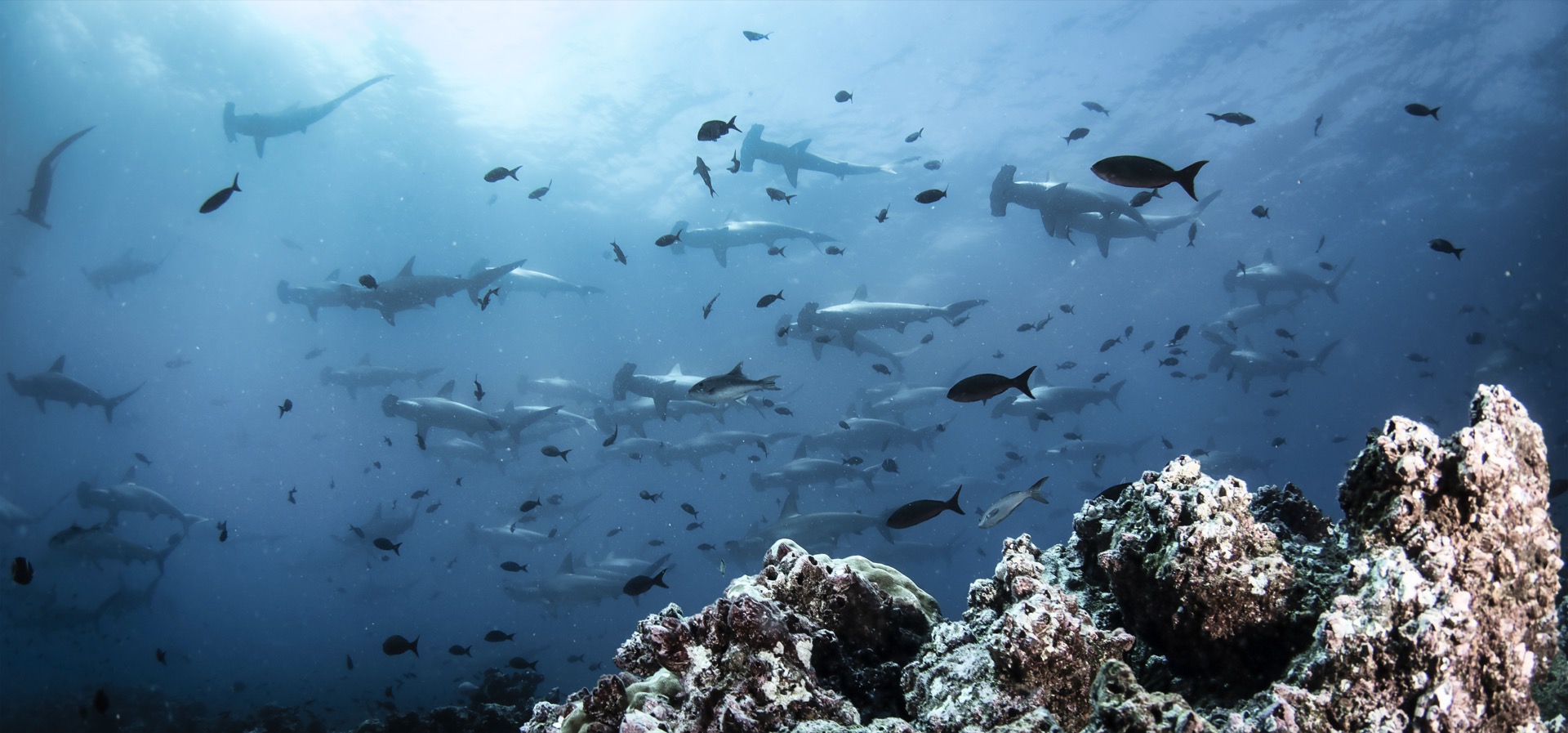
La Nevera (The Fridge). Aptly named. Cold upwellings push the water temperature down to 17 or 18 degrees here, which is where the hammerheads concentrate most densely. La Nevera is also Malpelo’s most famous cleaning station, where the hammerheads come to be cleaned by king angelfish and barberfish. Schools of hundreds are the peak-season norm; schools over a thousand have been recorded. This is a current-exposed site, and the descent matters. You drop, you find your hold, you wait, and the hammerheads cycle through above you in slow, deliberate spirals. This is the headline encounter most divers come for, and it earns it.
Bajo del Monstruo (Monster Shoal). A pinnacle off the northern end of the island, rising to around 30 metres. Whale sharks appear here regularly during the right windows. The currents are strong and the site is not divable on every weather day, but when it is on, the encounters tend to be prolonged. Whale sharks at Malpelo do not pass quickly. They cruise, sometimes for ten or fifteen minutes, divers falling alongside. The pinnacle itself is dense with leather bass, creole fish in clouds, and yellow-orange anemones across the rock.
Los Tres Mosqueteros (The Three Musketeers). A trio of seamounts on the island’s north side. One of the more accessible hammerhead sites at recreational depths, with the schools cycling through in mid-water above the rock. The geography of the three seamounts creates eddies the sharks seem to use, the encounters here can be sustained.
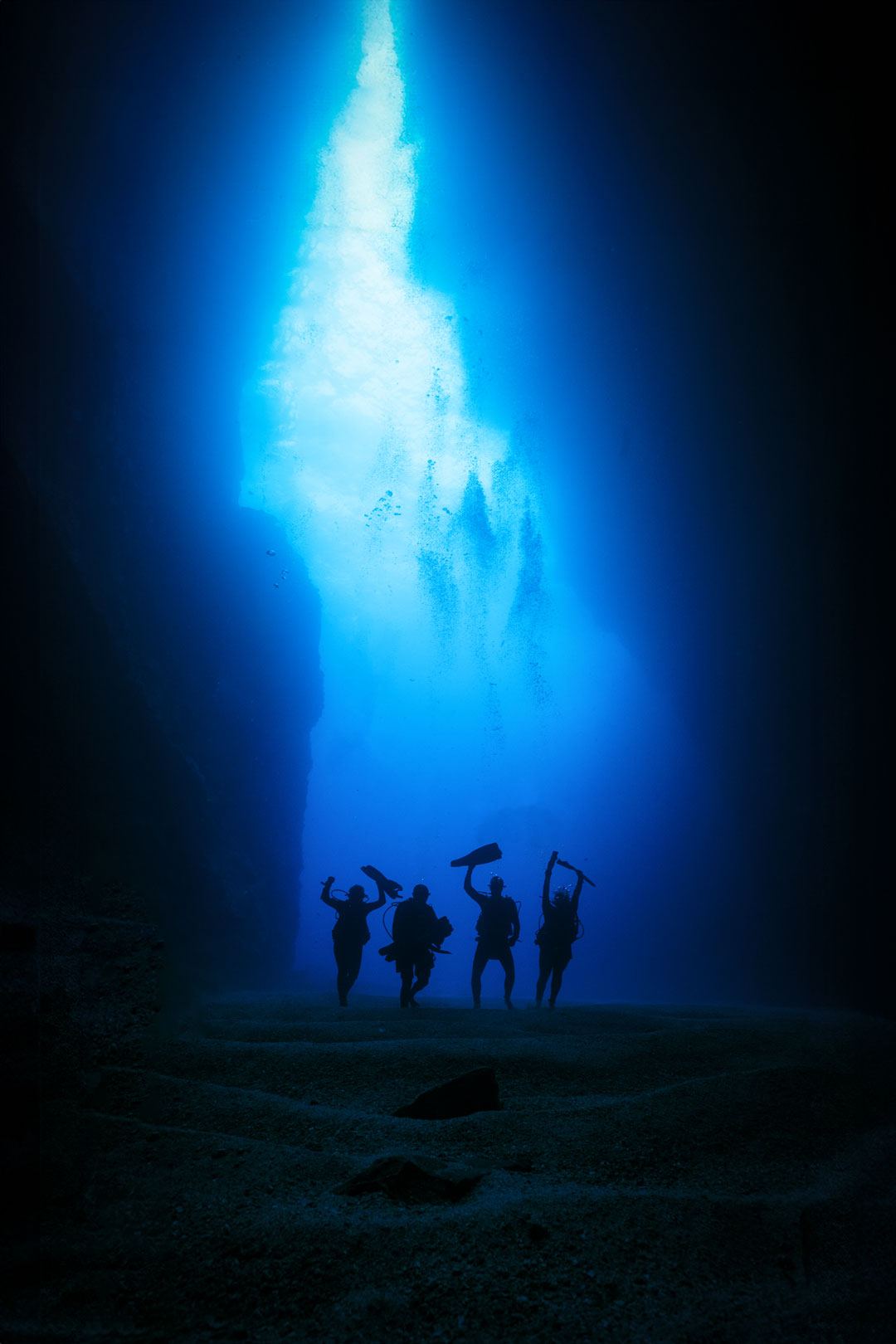
La Catedral (The Cathedral). A passthrough cave system on the eastern wall, with a narrow tunnel running through the rock. Inside the cave: clouds of bigeye trevally, schooling jacks, and resident moray eels in the cracks. This is the site for divers who like architecture as much as wildlife.
El Altar de Virginia. Hammerhead site with more colour than the bare-rock seamounts elsewhere on the island. Multiple eagle rays cruise here in the right season. Whitetip reef sharks rest in the shallower ledges. Hard coral coverage is denser than at La Nevera or Bajo del Monstruo.
La Cara del Fantasma (Ghost Face). A wall site named for the rock formations that resemble a face from certain angles. Pacific barracuda in dense schools, blue-and-gold snappers, and the same hammerhead and Galapagos shark presence as the headline sites.
La Gringa. A cave site with resident populations, harder to dive in heavy current but a sheltered alternative when the open seamounts are working too hard.
El Acuario (The Aquarium). A cold-water pinnacle site, exposed, with strong currents and dense fish life. Often the site where the rare smalltooth sand tiger sharks (Odontaspis ferox) are sighted in cold-water season.
La Ferreteria (The Hardware Store). A smaller pinnacle, only divable on calm days, exposed to the strongest currents on the island. Multiple eels, large scorpionfish, occasional dolphins working the perimeter. Not on every itinerary; ask if you have the conditions for it.
El Sahara. A sand-bottomed slope site where hammerheads and silkies cross between the deep blue and the reef structure. Less famous than La Nevera but a strong alternative when conditions push you off the better-known sites.
The crew on the Sea Wolf knows this island in detail and moves the itinerary with the conditions. You do not pre-book individual sites; you arrive, the divemasters check the surface, the current, the visibility, the swell, and they decide where the group goes that morning. Trust the call.
The Marine Life
Hammerheads are the headline. Scalloped hammerheads, in schools dominated by adult females, congregate at the cleaning stations and along the seamount edges. The schools tend to hold deeper during the day and rise toward the surface at dusk; the best encounters are often on the late-afternoon dive.
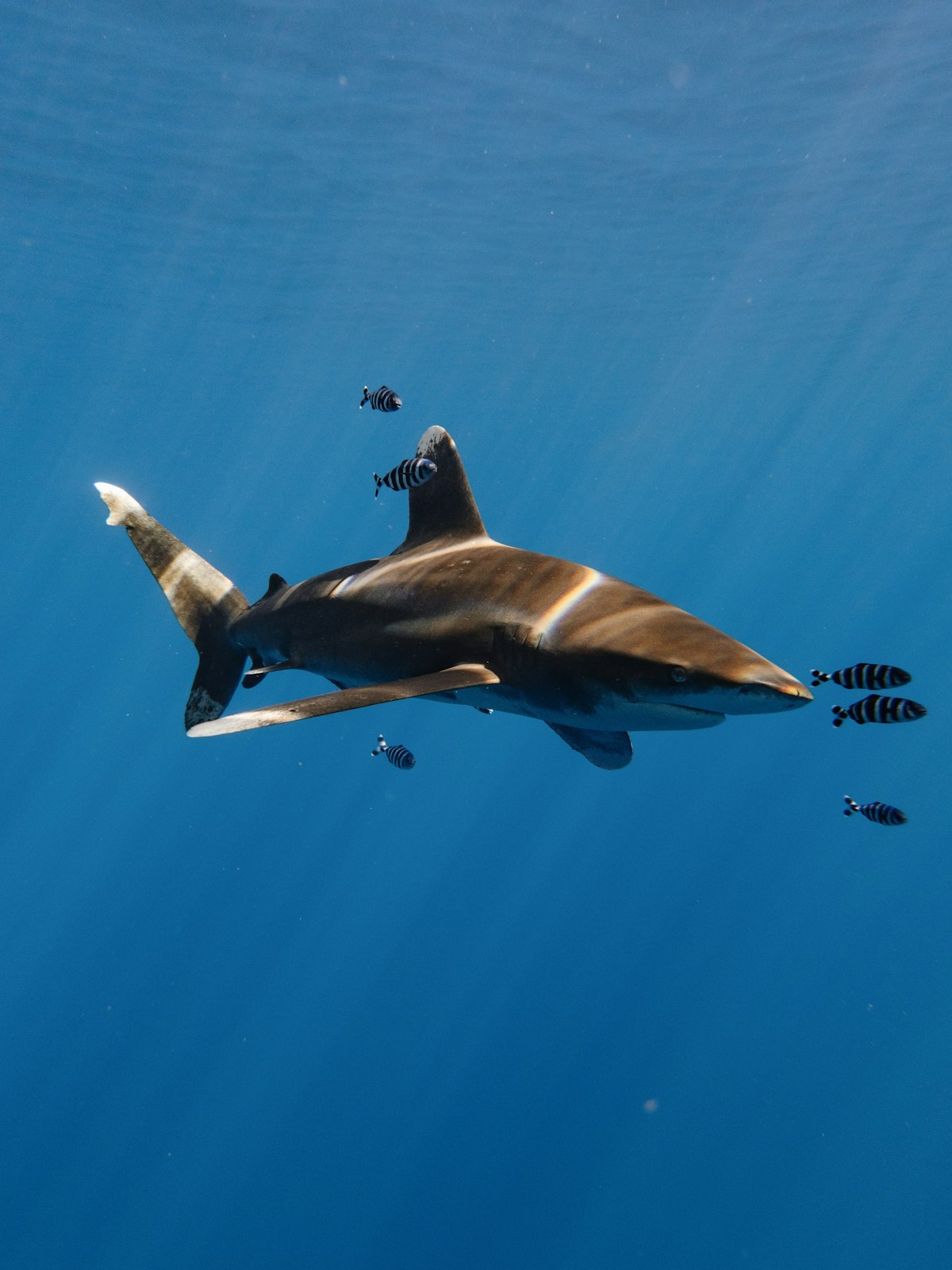
Galapagos sharks patrol the deeper drop-offs in groups of two to four, larger and broader-shouldered than the silkies, occasionally cruising in among the divers near the reef edge.
Silky sharks are present on essentially every dive. They circle. They are curious. They are the species you stop noticing because there are simply too many of them.
Whitetip reef sharks rest under ledges and in crevices in numbers that take a few dives to register. They are dense enough on the day dives that a quiet hover over a ledge will usually find a stack of them resting motionless in the cracks.
Whale sharks appear throughout the year, more reliably between July and November. The Malpelo whale sharks are not the small juveniles you see at coastal aggregations elsewhere, they are full-sized adults, often eight metres or more.
Smalltooth sand tiger sharks (Odontaspis ferox) are Malpelo’s deep-water specialty. The Ferox liveaboard is named for this species. They live mostly below recreational depths, but in the cold-water season from January through April, the upwellings bring them up to depths divers can see. A ferox sighting at Malpelo is a true once-in-a-trip moment.
Tiger sharks were historically rare here. Recent years have brought a clear shift, with sightings becoming notably more common. We logged four on a single eight-day expedition. That trend is part of a broader change in Malpelo’s pelagic mix that scientists are still working to interpret.
Mantas and eagle rays appear at the right sites in the right windows.
Orcas, until October 10th, 2024, had never been formally recorded at Malpelo. Three orcas were spotted at the surface from the boat during a between-dive interval. The sighting was confirmed by Parques Nacionales Naturales the same evening. The hypothesis from the marine biologists on the boat that day was that the animals are following changing food sources, possibly tied to El Niño shifts. Whether they will return is an open question. We were fortunate to be there for that single window.
The sum of all this is that Malpelo consistently records more shark species per dive than almost any other site in the world, and the species mix is still evolving. None of that happens by accident. It is the direct product of marine protection at a level that has held for thirty years, and the constant pressure of the global shark fin trade that keeps testing the perimeter.
The Conditions
Water temperature ranges from 17 to 27 degrees depending on which water mass is dominant during your trip. The deeper sites and La Nevera are reliably cold; the shallower reef sites can sit in warmer water at the same time. In October, a 5mm wetsuit was generally adequate for me on the dives we were doing, with the caveat that gloves are mandatory and a hood is strongly recommended. For January-to-April trips, when the upwellings push the water into the high teens at depth more often, divers stack up to 7mm or move to drysuits.
There are no night dives at Malpelo. The Sanctuary regulations do not permit them. Plan your gear and your itinerary on day-dive operations only.
Visibility averages 15 to 25 metres but is highly variable. Productive upwellings, which is exactly what makes the marine life dense, also push thicker green water through. A great wildlife day and a poor visibility day are often the same day.
Currents are real, persistent, and directional, often shifting through the dive. The negative entries and gloved hand-holds on the rock described above are how the diving works at every site. The crew briefs the current expectation for every dive.
The Pacific crossing itself can be rough. Antihistamine-based seasickness medication is worth packing, and worth taking before you leave the dock rather than after the swell starts. Cabins on the lower deck are quieter and steadier than upper deck cabins on the crossing.
A Note on the Personal Locator Beacon
A personal locator beacon, typically a Nautilus Lifeline GPS or equivalent, is part of the mandatory dive kit at Malpelo. It is not optional, and the requirement is taken seriously by the operators and by the Colombian park authority that polices the Sanctuary.
The reason is direct. On 1 September 2016, five divers from the Maria Patricia were swept off a Malpelo dive site by current. Three were eventually recovered alive after drifting for hours and into the next day, picked up tens of nautical miles from the island. Two did not come home: Erika Vanessa Diaz, whose body was recovered ten days later 140 nautical miles from Malpelo, and Carlos Jimenez, the dive guide, who was never found. According to the surviving divers, the group did not have Nautilus Lifelines or strobes with them on that dive.
The personal locator beacon is what closes that gap. On a current-exposed open-water dive at Malpelo, the realistic worst case is being swept off the seamount and into the Pacific without the boat seeing your SMB. A PLB allows the boat, the navy, and the coast guard to find you. Most operators, including DivingLife, provide one for every diver as part of the trip kit. Wear it on every dive. Activate it if you are separated. The system works.
Why Go
There are dive destinations with better visibility, warmer water, and easier logistics. Malpelo is not those places. What it offers is something almost nowhere else does anymore: a fully wild ocean encounter at a place so remote that the apex predators outnumber the divers by orders of magnitude, in a marine sanctuary that has held its protections for three decades and is showing visible biological response to that protection in the form of recovering populations and unprecedented sightings.
If you came to diving for the marine life, Malpelo is the destination that will reset your sense of what is possible. If you have done Cocos, the Galapagos, the Maldives, this is the next step. If you have not done any of those, you can absolutely start here, with the right preparation and the right operator.
A note on the operator: we went with DivingLife on the Sea Wolf and would not hesitate to go with them again. We continue to recommend them to anyone diving the area. For everything else Colombia offers above the waterline, the Caribbean coast around Santa Marta is the warmer, shallower, more accessible counterpoint to Malpelo.