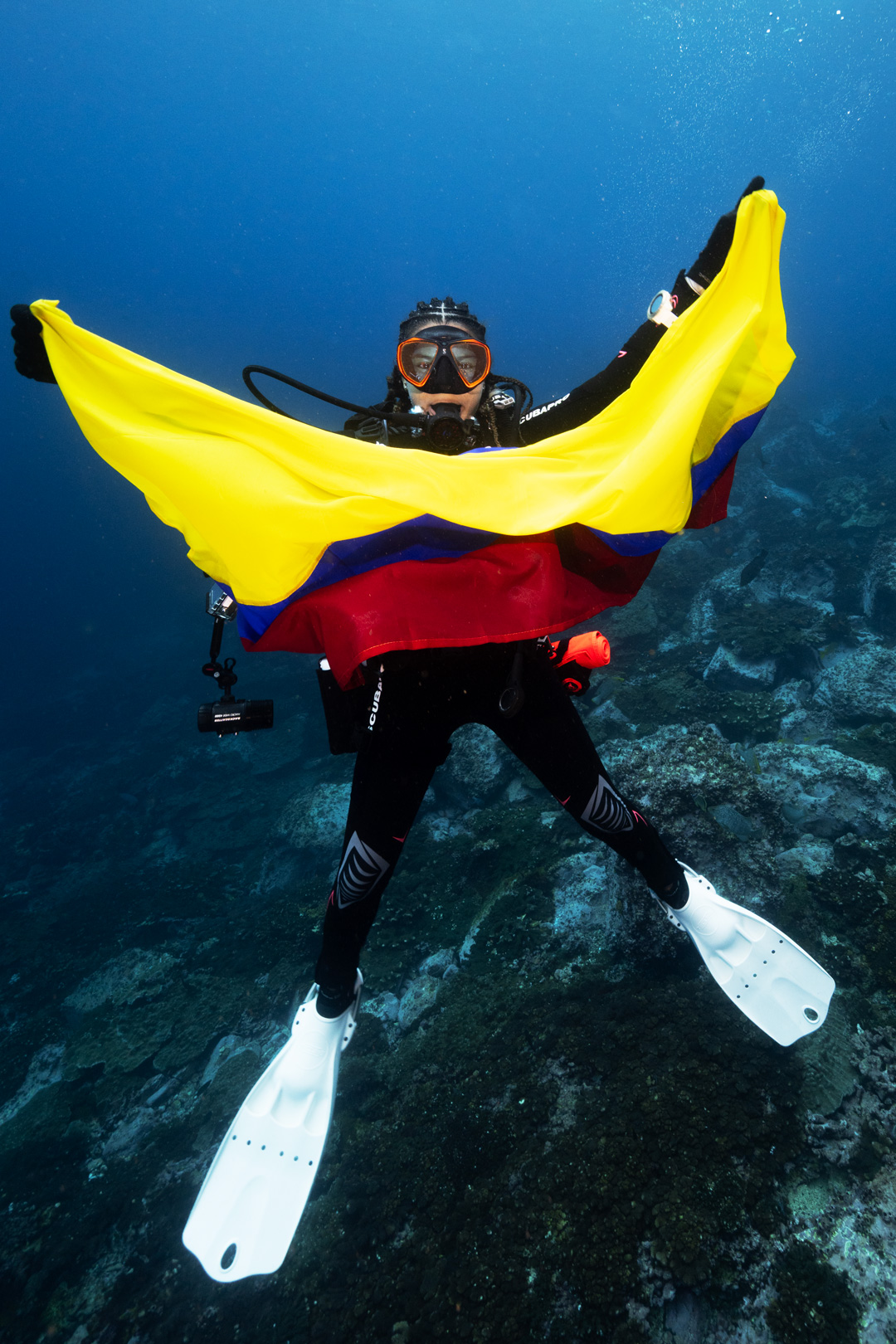
When divers list the world’s great destinations, the same names come up. Egypt. Indonesia. The Maldives. Thailand. Australia. Mexico. They are the right names. They are also incomplete. The country that comes up least, given what it actually offers, is the one I keep telling other divers about. Colombia.
I am biased, of course. I am Colombian. I grew up landlocked in Medellín, spent the years that followed moving around the world, only learned to dive in my late twenties, in other people’s countries, and have since travelled and dived across four continents. Colombia is one of the countries I have come back to on dive trips, and one of the few I will keep coming back to. What I have learned, dive by dive, is that Colombia has two completely different world-class dive environments inside one country, from beginner-friendly reef in warm Caribbean water to one of the planet’s apex pelagic destinations on the Pacific. There is almost nowhere else on Earth where you can do both inside the same border.
Here is why Colombia keeps getting left off the list, and why that is going to change.
Two Coasts, Two Oceans, Two Different Worlds
Most divers who think Latin America think Caribbean. Mexico, Belize, Honduras, Bonaire. Colombia is the only country in South America with both a Caribbean and a Pacific coastline, and the two could not be more different.
The Caribbean side is what most divers expect. Warm, clear, full of reef. Visibility is comfortable, the temperature sits in the high twenties, and the sites are run from local boats on short trips. A new diver can be doing checkout dives one day and joining drift wall dives the next. The Pacific side is the opposite. Cold, current-heavy, deep, and home to some of the densest shark populations on the planet. It is a destination for divers who already have logbooks. The crossing alone takes 36 hours.
You can do both in one trip. You can also do either of them without ever running into another foreign diver, because Colombia has not been marketed the way Indonesia or Egypt have. The price of that for the dive industry has also been, paradoxically, a gift to those who get here first.
The Caribbean Coast: Where Most Trips Start
Santa Marta and Tayrona National Park
The dive sites along the coast east of Santa Marta sit inside Tayrona National Park, a protected area since 1969. The walls and reef structures inside the park sit between eight and thirty metres, covered in sea fans, brain coral, and great domes of star coral that look like small cathedrals when the light hits them from above. Marine life includes barracuda, eagle rays, octopus, the occasional turtle, and a strong macro scene if you know how to slow down.
What makes Tayrona different is what is not here. Crowds. The park sites have seen a fraction of the diver volume that Cozumel or Utila have absorbed in the same decades. The fish are less wary. The reef is healthier. And the protected status has held for long enough that the comparison between the bays inside the park and the bays nearer Santa Marta’s commercial port is, by now, a real conservation story in its own right.
I have written about diving Tayrona National Park and the port question on the Santa Marta coast in detail. It is the dive the rest of this article assumes you can do.
The Rosario Islands and Cartagena
Two hours by boat off Cartagena’s old town, the Rosario Islands and San Bernardo archipelagos sit on the Caribbean’s continental shelf. The diving here is shallower than Santa Marta, much of it between five and eighteen metres, and the conditions tend toward easy reef and mangrove edges. It is a beginner’s playground. There is a Marine Protected Area too, the Corales del Rosario y de San Bernardo National Natural Park, and the reef inside it is in markedly better shape than reef outside it.
If you have come to Cartagena for the colonial architecture and the food and you have a few days, you can dive Rosario and be back in the city for dinner. It is one of the easiest add-ons in Caribbean diving.
San Andrés and Providencia
Eight hundred kilometres off the Colombian mainland, sitting much closer to Nicaragua than to mainland Colombia, San Andrés and the smaller, quieter Providencia are part of the Seaflower Biosphere Reserve, the largest marine protected area in the Caribbean. The water is clearer here than anywhere else in the Colombian Caribbean. The reefs are deeper, the walls are bigger, and the coral system is one of the most extensive in the wider region.
San Andrés is more developed and easier to reach. Providencia is the diver’s island. Small, isolated, and home to dive sites like Felipe’s Place and Manta City, where pelagic encounters are part of normal trips. For divers who want clear Caribbean water and a less developed feel, this is the destination on this coast. DivingLife runs trips here as well as to Malpelo. I would not hesitate to go with them again, and I continue to recommend them to anyone diving the area.
Capurganá and Sapzurro
Up against the Panamanian border, on the Darién coast, Capurganá and Sapzurro are dive towns nobody talks about. Reef diving with reasonable visibility, almost no other divers, and a rugged jungle-meets-Caribbean feel that has not survived on the more developed parts of the coast. You can come here with a backpack and a casual attitude and have a perfectly good week. You will probably also meet the same five other foreigners every day, because nobody else has come.
The Pacific Coast: Where the Diving Goes Big
The Colombian Pacific is a different planet. The water is colder. The visibility is more variable. The currents matter. And the marine life is an order of magnitude more dramatic than anything on the Caribbean side, because the conditions that make this water tough are the same ones that concentrate sharks, whales, billfish, and rays into seasonally enormous aggregations.
Malpelo
The big one. Malpelo is a 350-hectare rock 500 kilometres off the Pacific coast, a UNESCO World Heritage site and one of the planet’s most important shark sanctuaries. It is liveaboard-only. The crossing from Buenaventura takes 36 hours. The diving is for divers with at least 50 logged dives, often more. And it is unlike almost anywhere else.
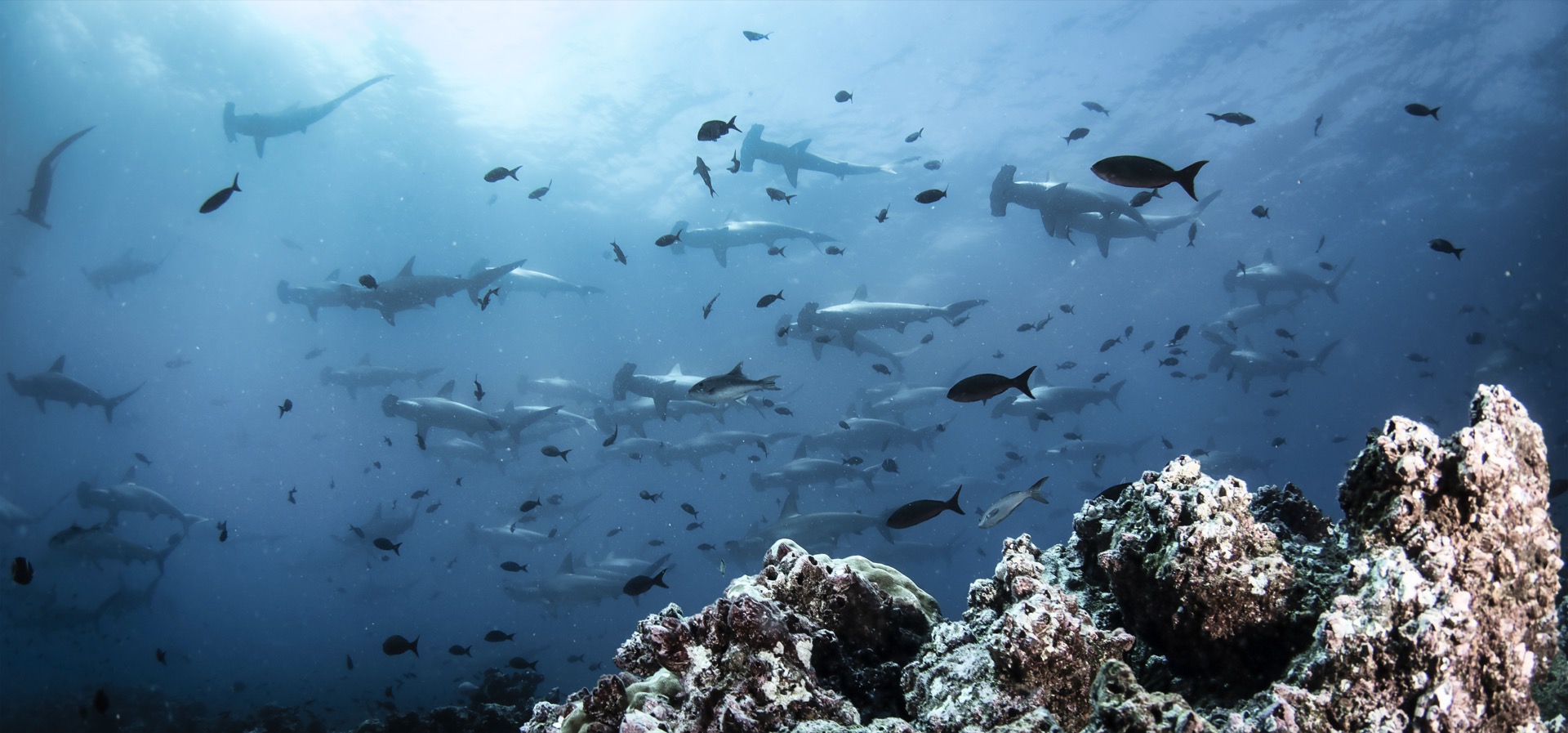
I have written the long version of what diving Malpelo is actually like, but the short version is this: hundreds of hammerheads, schools of silky sharks, Galápagos sharks patrolling the drop-offs, whale sharks year-round, and the kind of pelagic concentration most divers travel to Cocos or the Galápagos for. The crew on permanent station at the island are part of a tiny patrol keeping illegal fishing vessels away, which is part of why the diving is what it is.
If you want to dive Malpelo, DivingLife is the Colombian operator I have used and would use again.
Gorgona
Once a brutal island prison, now a national park, Gorgona sits 35 kilometres off the Pacific coast and offers diving that nobody talks about because Malpelo overshadows everything in the same breath. That is unfair. Gorgona has accessible reef diving, schooling fish, sea turtles, occasional humpback encounters in season, and access without the 36-hour crossing. From July to October, humpbacks transit through these waters from Antarctica with newborn calves. You can dive in the morning and surface to whale song in the afternoon. DivingLife runs Gorgona expeditions alongside their Malpelo programme, and the same standards apply.
Bahía Solano and Nuquí
Further north on the Chocó coast, Bahía Solano and Nuquí are the gateway to whale-watching season for Colombia. Diving here is more limited and more weather-dependent, but there are operators running dives for advanced divers willing to work with the conditions. The trade-off is that the same waters are humpback nursery grounds, and seeing a thirteen-metre adult and a calf passing close to the boat between dives is not unusual. This is the Pacific at its wildest, and the diving is a side benefit of being there.
Diving Colombia at Every Level
Part of why Colombia is so underrated is that it works at every certification level, and you can string the levels together inside a single country.
Discover Scuba and Open Water. Santa Marta, Cartagena, San Andrés. Warm water, manageable depths, easy navigation. The shore-based shops on the Caribbean coast run Open Water and Advanced courses every week.
Advanced Open Water. Tayrona walls, Providencia drift dives, Rosario reef extensions. Visibility is consistent and conditions teach without punishing.
Wreck and drift specialty divers. Wrecks off Santa Marta, current-heavy sites in Providencia, drift profiles in Tayrona.
Pelagic and expedition divers. Malpelo and Gorgona on the Pacific. Liveaboard-only at Malpelo, supported expeditions at Gorgona. Nitrox helpful, deep certification often required.
Photographers. Both coasts. Macro on the Caribbean side (the nudibranch life on the Tayrona reefs rewards a slow camera), wide-angle pelagic on the Pacific.
You can certify in Cartagena and end your trip on a Malpelo liveaboard. There is no other South American country that lets you build a diving life like that without ever crossing a border.
Why Colombia Is Underrated
A few reasons.
First, the country had decades of bad press the international dive industry never quite shook. The scuba market is conservative. Destinations build slowly, and Colombia spent the years when Indonesia and the Maldives were getting marketed in dive magazines being absent from those magazines for reasons unrelated to diving. The reputation lag is still working through the system.
Second, the diving infrastructure is local, not international. The shops are small, owner-operated, mostly Colombian. There is no global resort chain shipping branded blue boats across the Caribbean. That has been a blessing for the reef and a structural disadvantage for visibility.
Third, the Pacific is hard. Malpelo is genuinely remote. The crossing is real. The conditions are demanding. That filters out most of the diver population who would happily tell their friends.
But all of these reasons are reasons of marketing and access, not reasons of substance. The dive sites themselves rank with anywhere on the planet for their respective categories. The combination, two coasts, two oceans, every level, all in one country with one of the most welcoming dive cultures in Latin America, is something nowhere else can offer.
What to Read Next
If you want to plan a trip, these are the next reads:
- Diving Colombia’s Caribbean Coast: Santa Marta for the Caribbean entry point.
- Malpelo, Colombia: The Shark Superhighway for the Pacific destination.
- How a Tiny Crew Keeps Malpelo Protected for the conservation story behind the diving.
- DivingLife: A Colombian Operator on Malpelo for the practical question of how to actually book it.
Colombia is not going to be the most underrated country to scuba dive in for long. The water is here. The reef is here. The sharks are here. The crowds are not. For now.