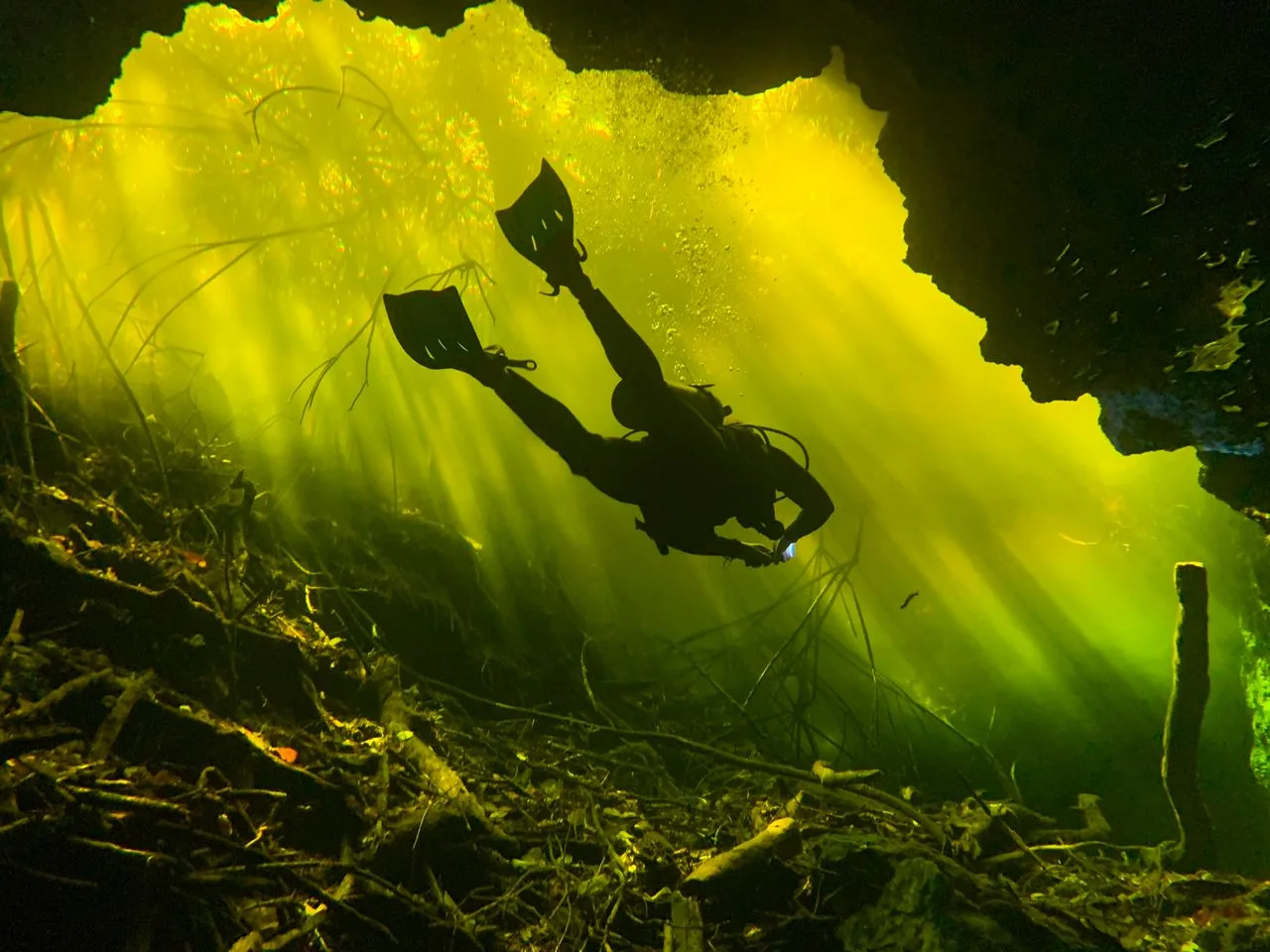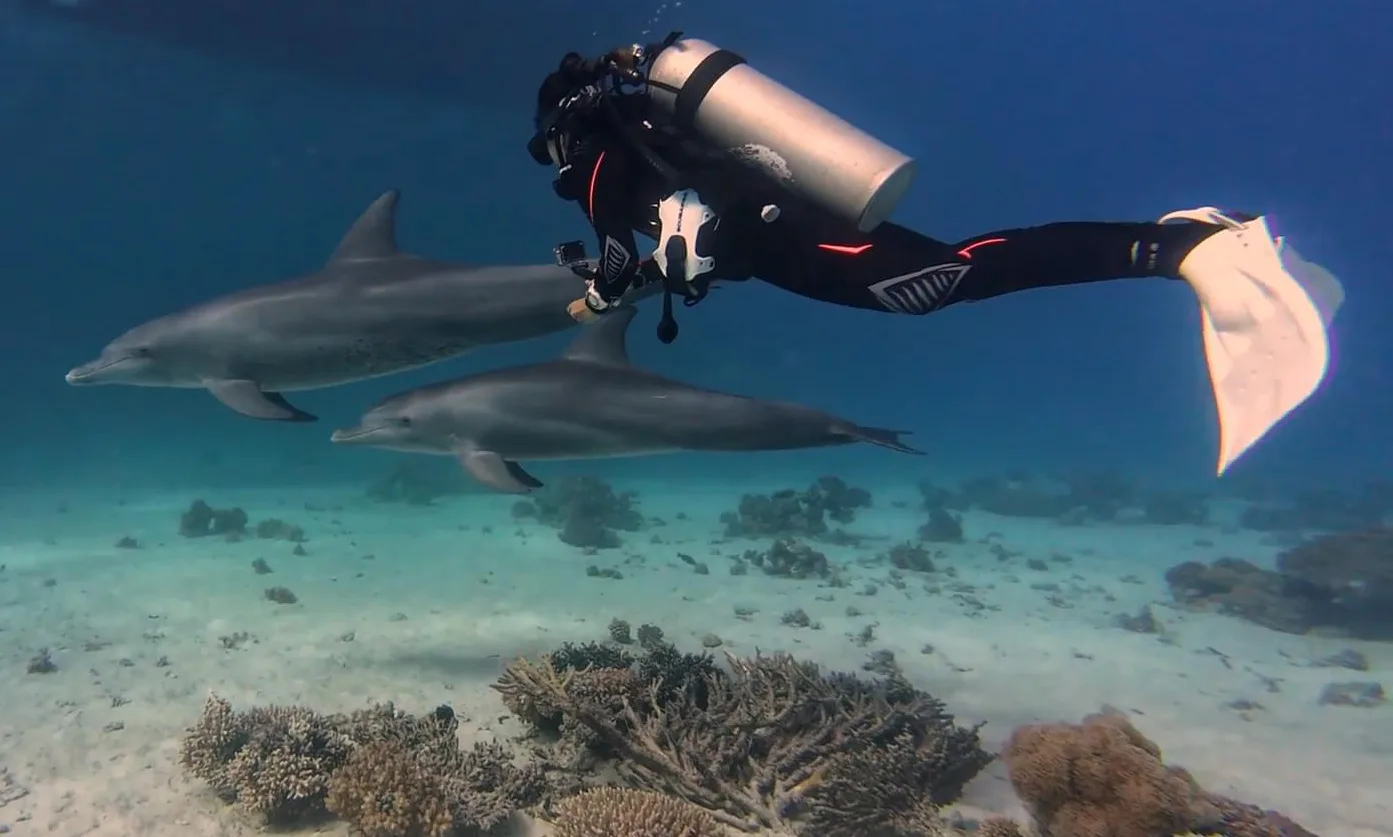
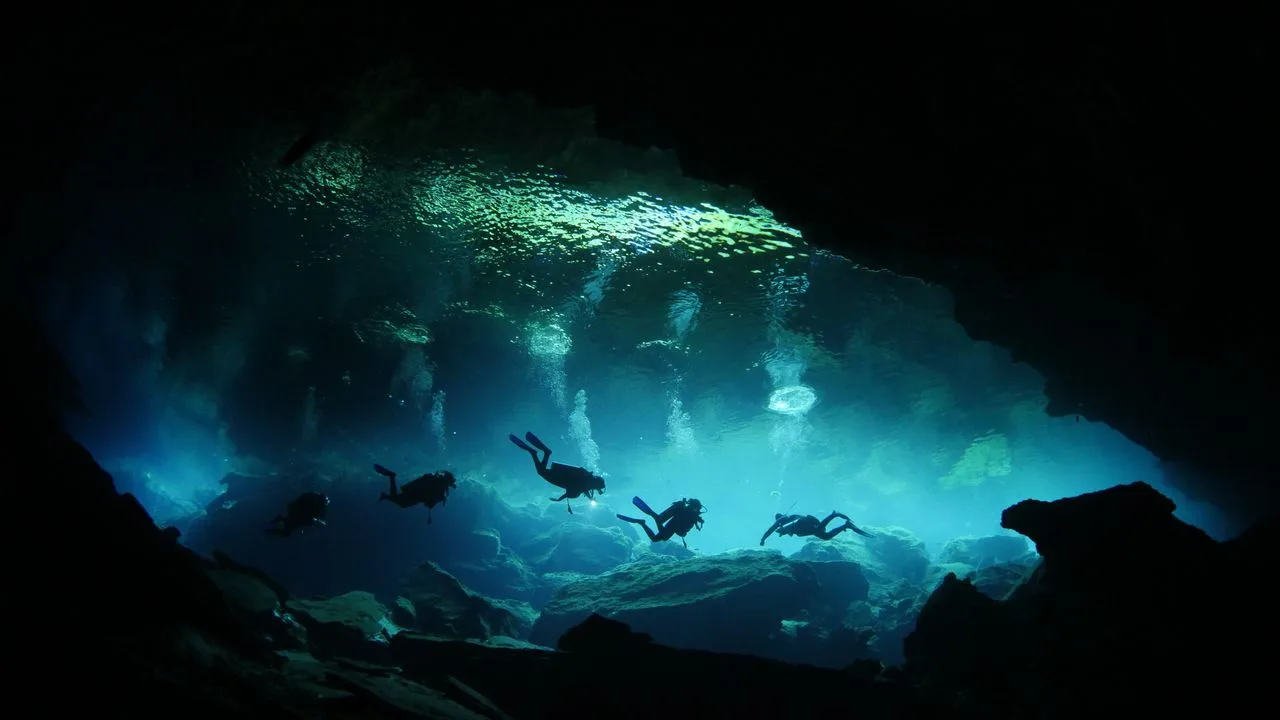
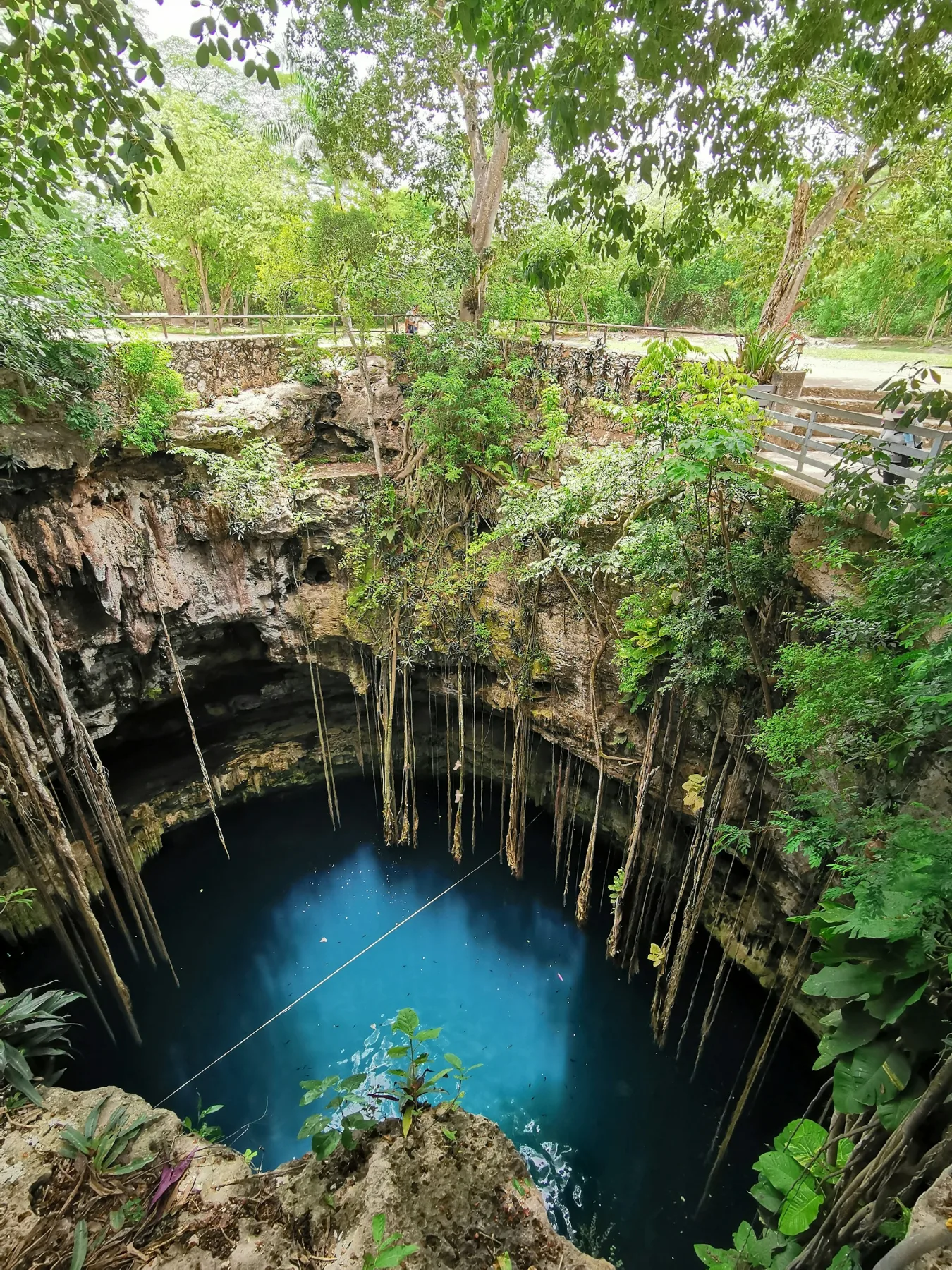
Diving cenotes in Mexico’s Riviera Maya feels closer to being in space than to any ocean dive I have done. A cenote is a sinkhole, formed where the limestone roof of a flooded cave has collapsed and left a window into the underground river beneath the jungle. The water is fresh, still and clear enough that the diver ahead of you appears to be hanging in air. You walk in from the jungle, the surface is flat as glass, and the whole dive moves at a slow, quiet pace.
I lived in Playa del Carmen for two years with the cenotes less than an hour inland, and I still think they are the best reason to fly to this coast with dive gear. They are also the dives people ask me about most before booking, and the question is nearly always the same: can I do this without a cave diving certification?
This guide covers the cenotes between Playa del Carmen and Tulum: what a recreational diver is allowed to do in them, which sites are worth your days, what the halocline and the light beams look like, and how to plan the trip around bases, costs, season and gear.
Cavern Diving vs Cave Diving: What Can Recreational Divers Do in the Cenotes?
Cenote diving covers two activities that start from the same pool, cavern diving and cave diving. Knowing which one you are booking is the most important part of planning, because the worst accidents in these systems have involved divers who crossed from one into the other.
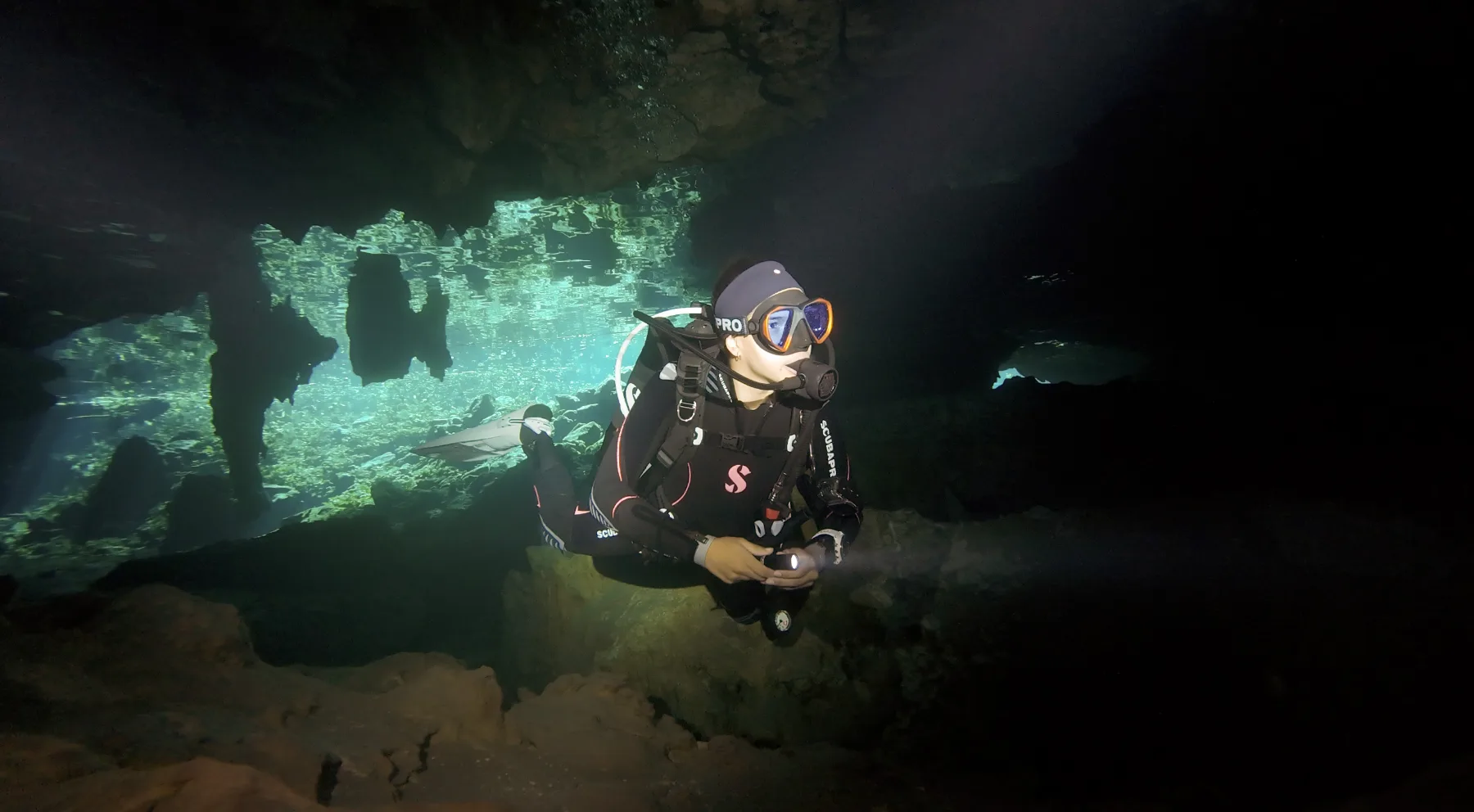
Cavern diving is what a visiting recreational diver does. You stay in the zone where daylight from the entrance is still visible, you follow a permanent guideline, and you are never more than 60 meters of swimming from open water. The training agencies set the depth limit for the cavern zone at 21 meters, and the passages on a guided route are wide enough for two divers to swim side by side, even though you travel in single file behind the guide.
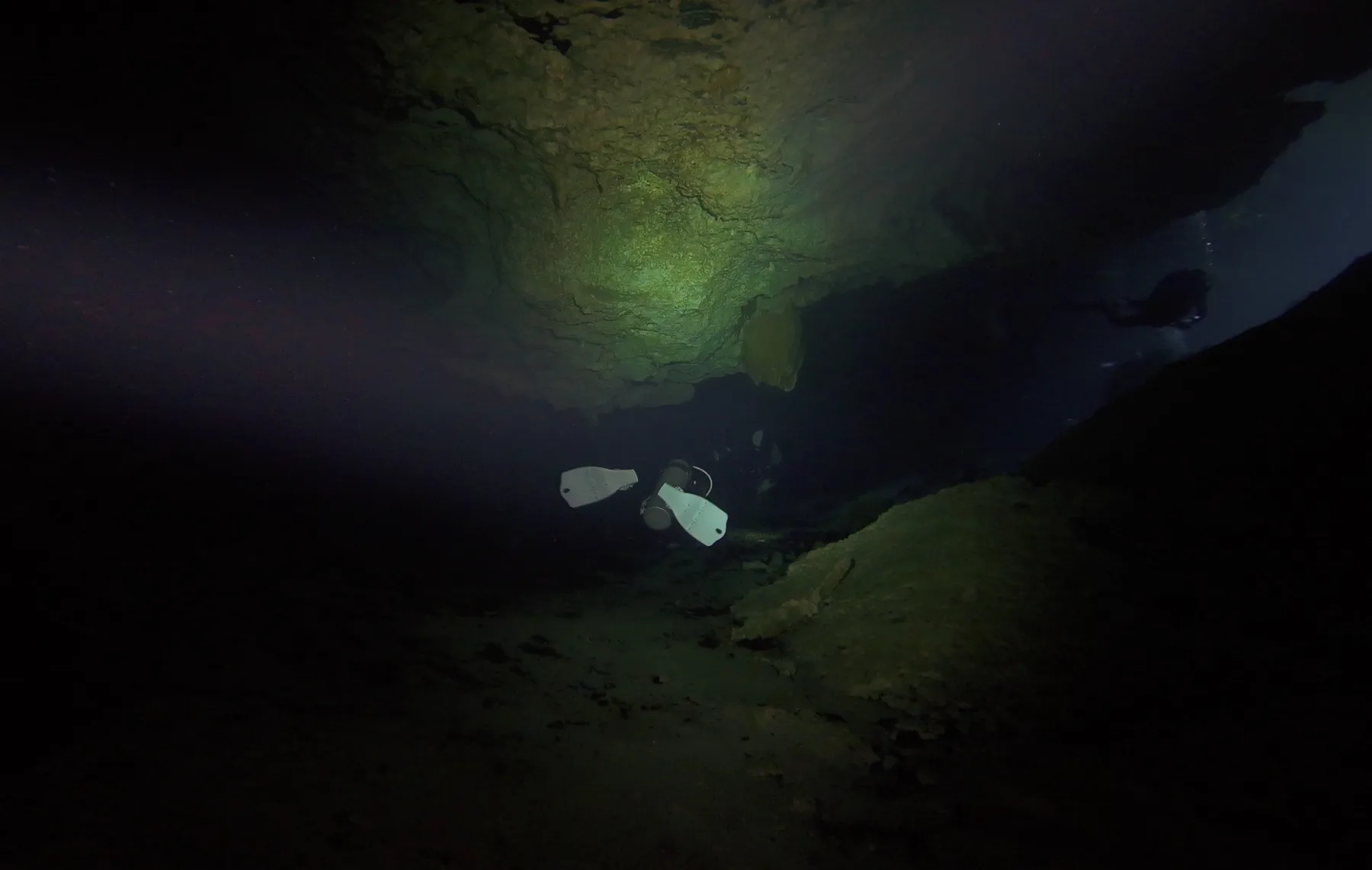
Cave diving starts where the daylight ends. The only way out is back along the line, the passages narrow, and a silt-out or a failed light becomes a problem you solve with training you already have. It requires a full cave certification, redundant tanks and lights, and several days of dedicated training. In most cenotes the boundary is marked with a warning sign carrying a grim reaper, and your guide will turn the dive well before it.
The rules that make guided cavern diving safe are consistent across reputable operators on this coast:
- Your guide holds a full cave certification on top of a divemaster or instructor rating, and dives in cave configuration with twin or sidemount tanks.
- Each guide takes a maximum of four divers.
- The group follows the rule of thirds: one third of the gas for the way in, one third for the way out and one third held in reserve.
- Every diver carries a torch, and the guide carries backups.
- Everyone stays on the line and inside the cavern limit.
If an operator offers to take you beyond the daylight zone without a cave card, or puts six divers behind one guide, book with someone else.
What certification level do you need for the cenotes?
On paper, an Open Water certification is all that operators ask for on the shallow cavern dives, usually together with a dive in the last twelve months, and some shops also want 15 to 20 logged dives. The deep cenotes, which are The Pit, Angelita and Zapote, require Advanced Open Water or a deep specialty.
My own view is stricter than the rule. I would wait until you are at the very least an Advanced Open Water diver, with enough dives behind you that buoyancy no longer takes conscious effort. A cavern asks for precise control from the first minute, with a ceiling above you, silt below you and formations within reach of your fins. Newer divers can struggle with that, and the struggle tends to end in one of two ways: anxiety that spoils a dive they paid a lot for, or a broken stalactite that took thousands of years to form. With that experience behind you, your attention goes to the light and the rock, and you get the dive you came for.
If you are still working toward your first certification, my guide on how to become a certified scuba diver covers the path and the costs.
How deep can you go in the cenotes?
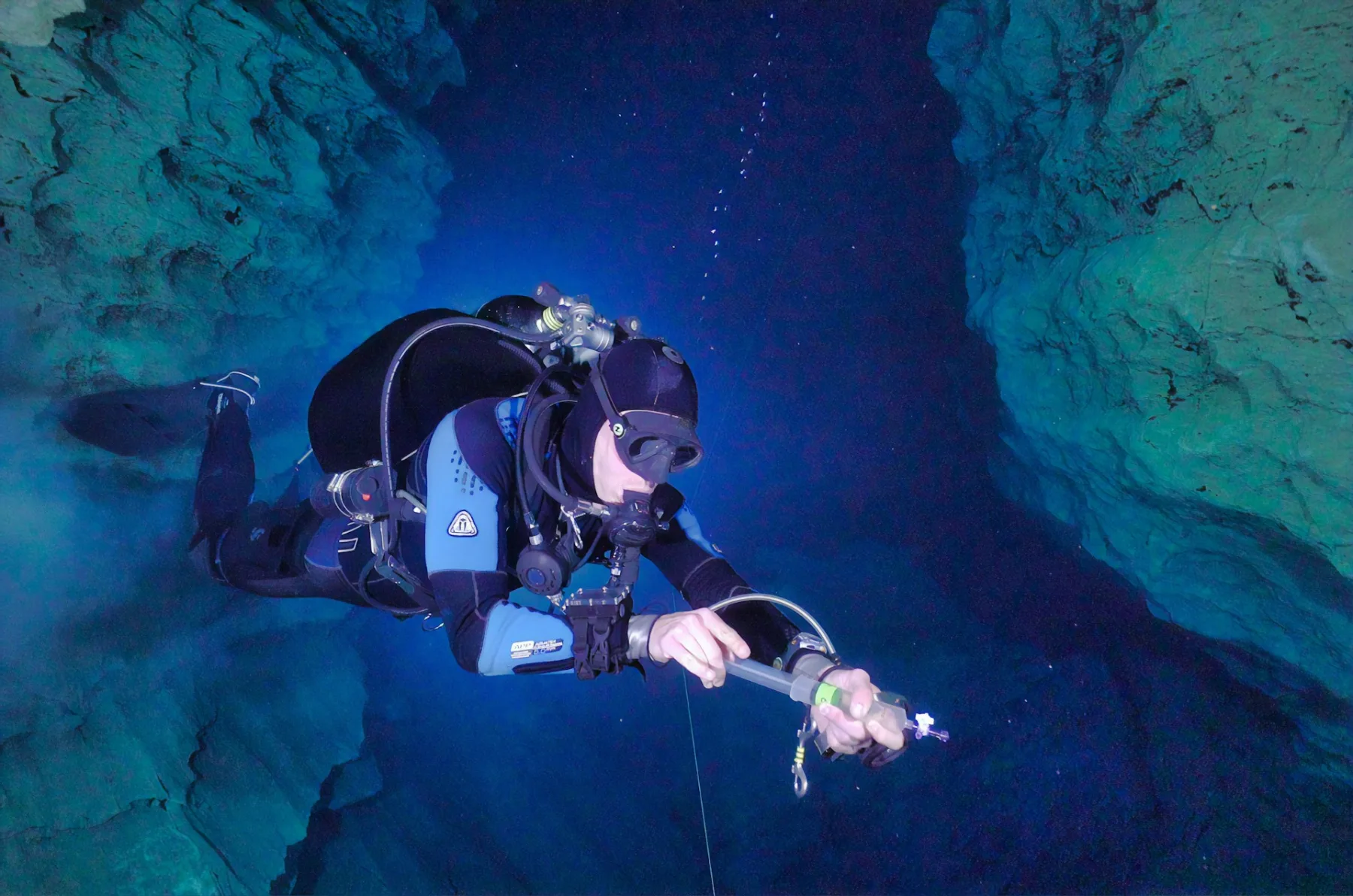
Depth limits in the cenotes follow your certification card, exactly as they do in the ocean. An Open Water diver is trained to 18 meters, an Advanced Open Water diver to 30 meters, and the Deep Diver specialty extends that to 40 meters, which is the ceiling for recreational diving.
Most cenotes sit well inside the first band. Dos Ojos, Chac Mool, Tajma Ha, Carwash and Casa Cenote all stay between 8 and 15 meters. Three are deep: The Pit, Angelita and Zapote. They are wide, sunlit shafts, and local operators run them beyond the 21 meter cavern standard for divers with the certification to match. Guided dives there usually turn at 30 meters, which needs Advanced Open Water, and some routes continue toward 40 meters, which needs the Deep Diver specialty.
Which Are the Best Cenotes for Diving in the Riviera Maya?
There are thousands of cenotes across the peninsula and a few dozen that dive shops visit regularly. They sit along the highway between Playa del Carmen and Tulum, most of them a short walk through jungle from a dirt parking lot. A cenote day is normally two dives, either two routes in the same cenote or two cenotes close to each other.
These are the ones I would build a first trip around, in the order I would dive them.
Cenote Dos Ojos
Dos Ojos is where most divers do their first cavern dive. Two routes leave from the same pool. The Barbie Line runs along the edge of the daylight zone through wide passages full of columns and stalactites, with blue light coming in from the side for most of the dive. The Bat Cave line is darker and circles an air dome where bats roost in the ceiling. Both routes stay around 10 meters, so the dives are long and unhurried.
Dos Ojos is also the busiest cenote on the coast and gets well over a hundred visitors on a normal day, many of them snorkelers. Ask for the first slot of the morning.
Certification: Open Water minimum · Depth: about 10 m · Drive: 20 min from Tulum, 45 min from Playa del Carmen
View on Instagram
Cenote Chac Mool and Kukulkan
These two share an entrance near Puerto Aventuras and make the easiest cenote day from Playa del Carmen. Kukulkan is a large open cavern where a curtain of light falls through the entrance in the morning, and it has a strong halocline at around 10 to 12 meters. Chac Mool adds a dome room packed with stalactites and an air pocket where the group can surface inside the rock.
Certification: Open Water minimum · Depth: about 14 m · Drive: 25 min from Playa del Carmen
Cenote Tajma Ha
Tajma Ha gives you the three things people come for in a single dive: light beams, a halocline and decorated rooms. The route passes under several small openings in the roof, and in summer the sun drops through them in narrow shafts. Look at the walls on the way, because the limestone is full of fossil shells from the reef this rock used to be. The line passes close to formations and through the halocline more than once, so guides prefer divers whose buoyancy is already steady.
Certification: Open Water minimum, steady buoyancy needed · Depth: about 14 m · Drive: 30 min from Playa del Carmen
Cenote The Pit
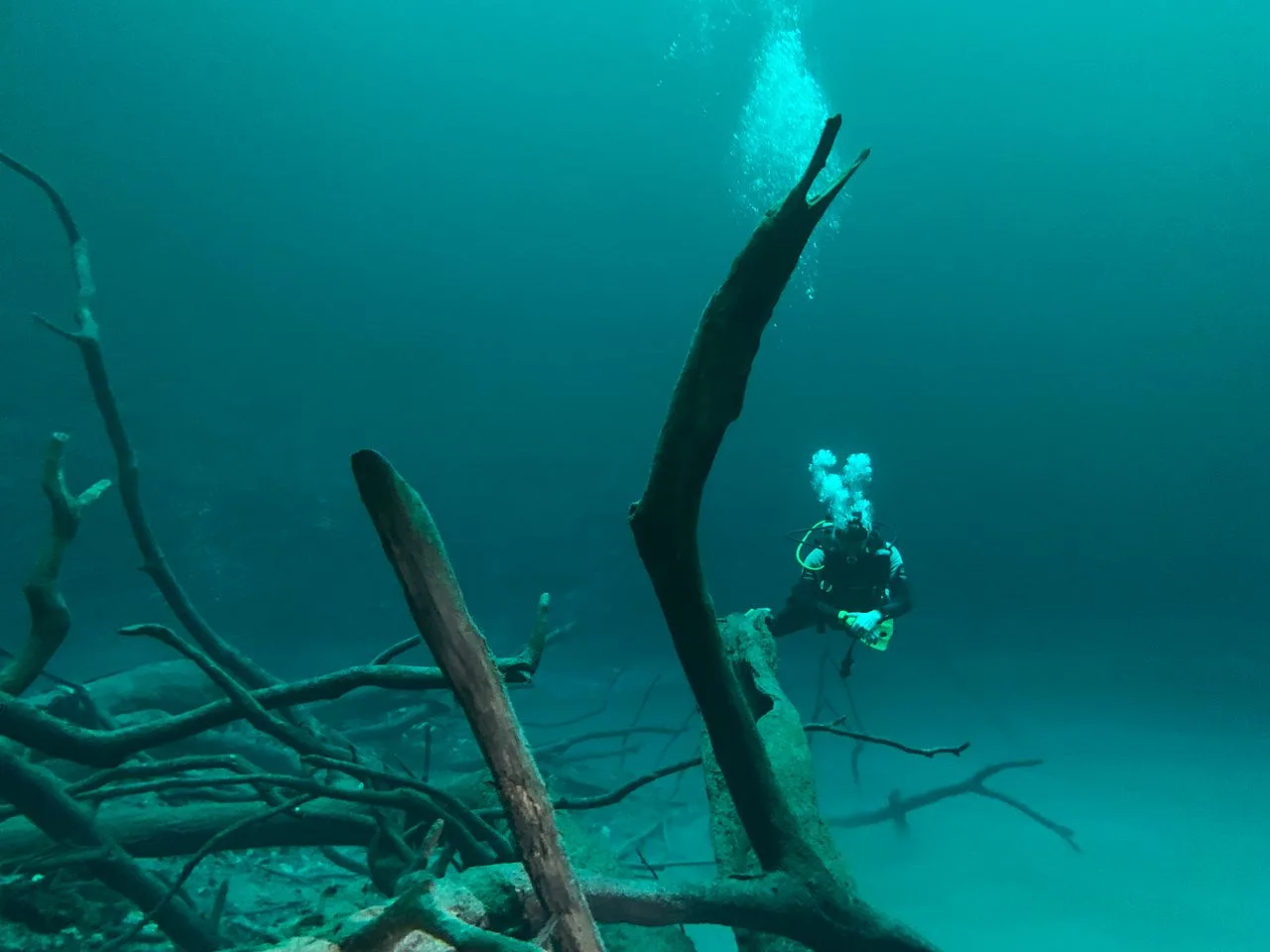
The Pit is a vertical shaft inside the Dos Ojos park, and it is the deepest known point in the whole cave system at 119 meters. The guided dive spirals down the walls to around 30 meters and back up. On a sunny day in summer the light beams reach most of that depth, there is a halocline on the way down, and at the bottom of the recreational range a hydrogen sulfide cloud covers the debris mound with dead branches reaching out of it.
Because of the depth, operators require Advanced Open Water for this dive.
Certification: Advanced Open Water · Depth: 30 m on most guided dives · Drive: 25 min from Tulum, 50 min from Playa del Carmen
View on Instagram
Cenote Carwash (Aktun Ha)
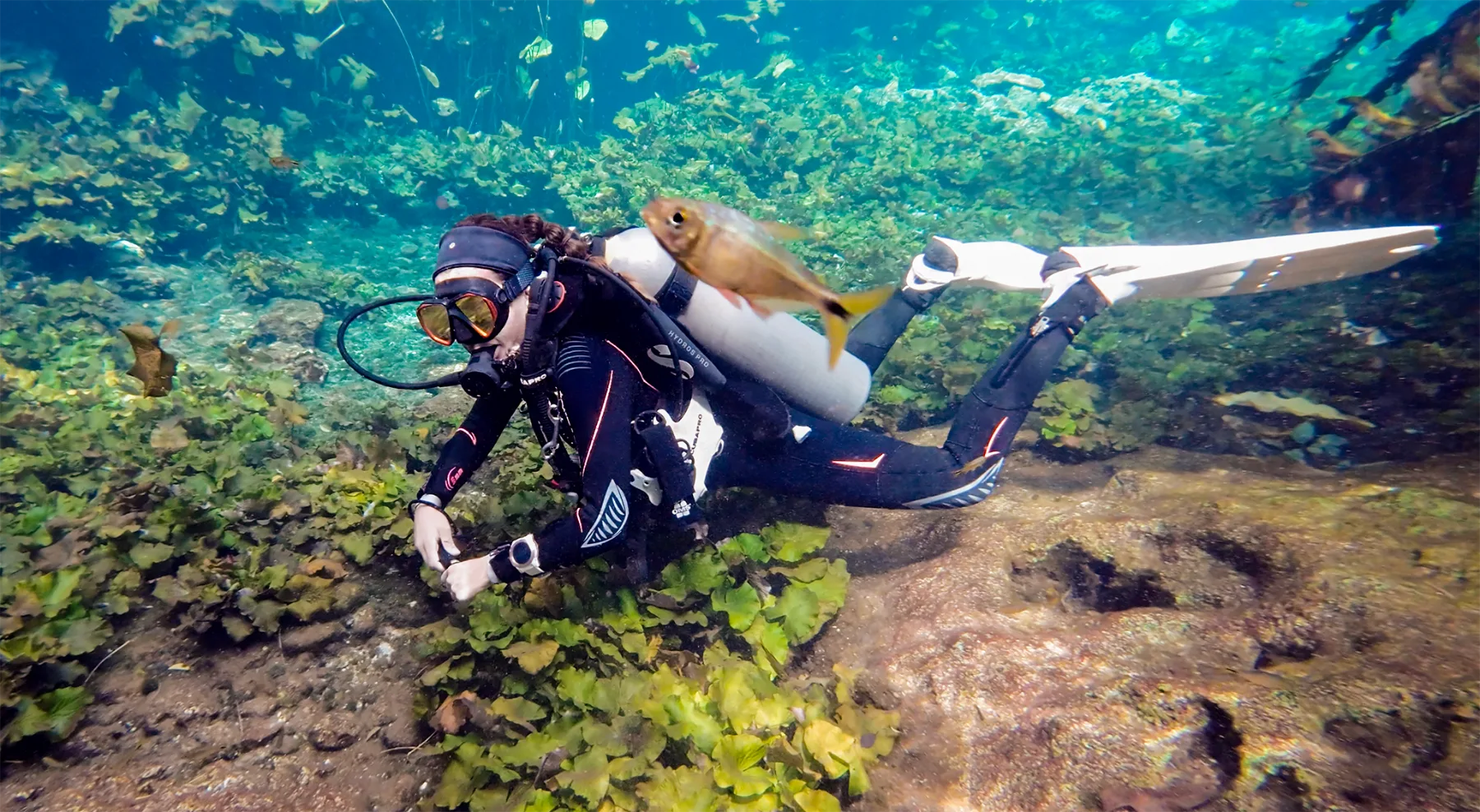
Carwash sits beside the road to Cobá and got its name from the taxi drivers who used to rinse their cars in it. The open pool is a garden of lily pads and submerged branches with more fish than most cenotes, freshwater turtles, and occasionally a small crocodile. The cavern behind it is wide and well decorated. In the warm months a layer of algae forms near the surface and tints the light green and gold as you swim underneath.
Certification: Open Water minimum · Depth: about 15 m · Drive: 10 min from Tulum
Cenote Casa Cenote
Casa Cenote is the gentlest introduction of all. It is an open channel that winds through mangrove roots and passes under the coast road to connect with the sea, so you get fresh water on top, salt water below and a mix of fish from both. It is also home to a small crocodile that the guides call Panchito, who is often seen resting on the rocks at the edge of the mangroves and keeps to himself. The maximum depth is around 8 meters and open sky is overhead for most of the dive. It works well as a first cenote or a second dive after Angelita.
Certification: Open Water minimum · Depth: about 8 m · Drive: 15 min from Tulum
Cenote Angelita
Angelita is an open sinkhole in the jungle south of Tulum, round and around 60 meters deep. At 30 meters a thick white hydrogen sulfide layer stretches from wall to wall, with a mound of earth and bare trees rising through it, and from above it looks like a river running through a forest at night. Open sky is above you for almost the whole dive. The challenge is the depth and the low light, which is why it is another Advanced Open Water site.
Certification: Advanced Open Water · Depth: 30 m · Drive: 20 min from Tulum
Cenote Dreamgate
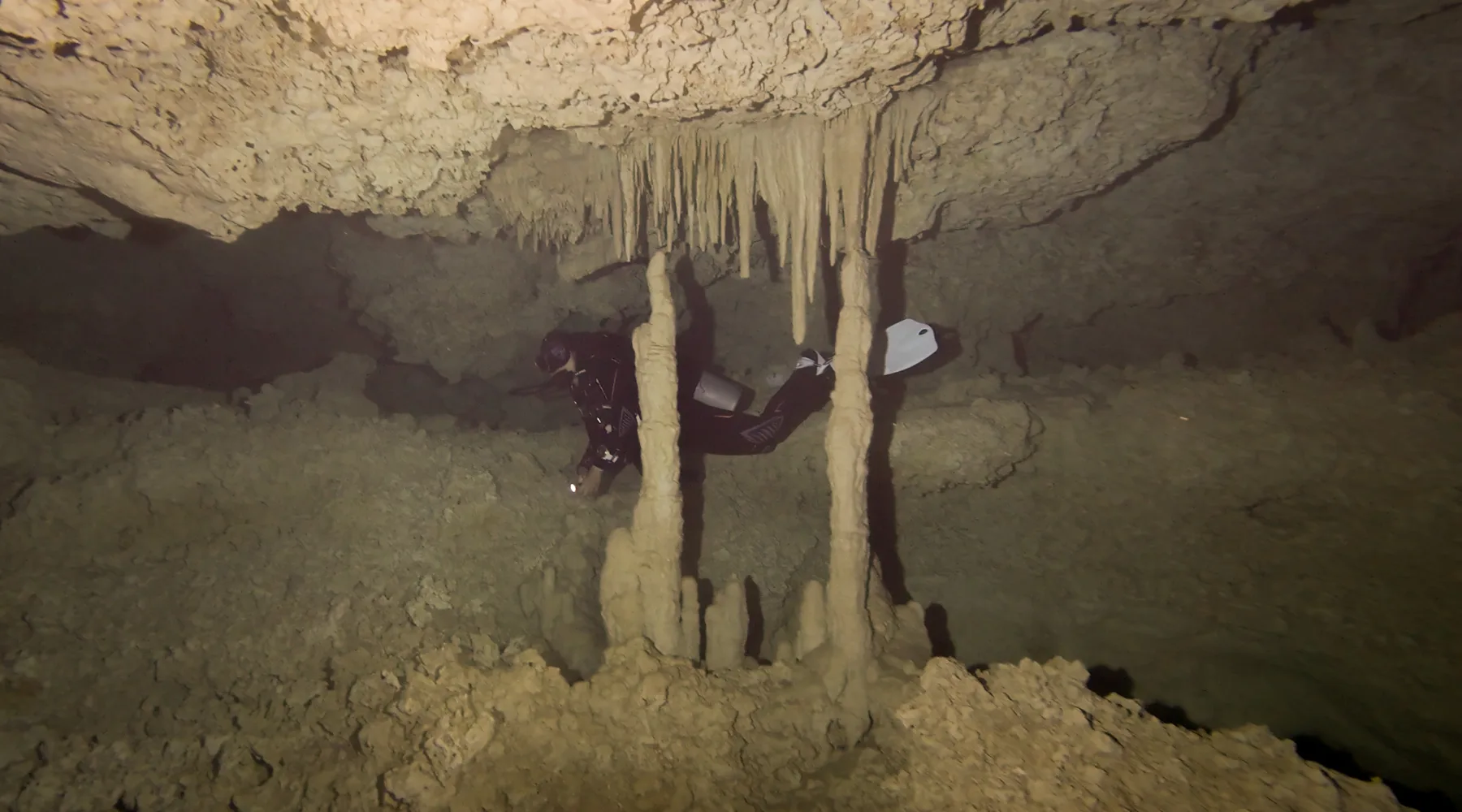
Dreamgate is shallow, at 6 or 7 meters, and it is the most densely decorated cavern that recreational divers can enter. Thousands of thin stalactites hang within arm’s reach of the line and the floor is fine silt. Guides normally take divers here after seeing them on another cenote dive first.
Certification: experienced divers, at the guide’s discretion · Depth: about 7 m · Drive: 25 min from Tulum
If you have more days, ask about Calavera, also called the Temple of Doom, which has three holes in its roof and a halocline you cross several times, and Zapote near Puerto Morelos, where bell-shaped formations known as Hells Bells hang at around 30 meters.
What Do the Halocline, the Light Beams and the Hydrogen Sulfide Cloud Look Like?
Three things make cenote diving look the way it does in photographs, and each one changes how you dive.
The halocline
The peninsula is porous limestone, so seawater pushes in underneath it from the coast and rainwater sits on top of that seawater as a floating lens. The boundary between the two is the halocline. Near the coast it can be as shallow as 10 meters, and it gets deeper the further inland you go.
The first time I descended into The Pit and reached the halocline at around twelve meters, I stopped. The boundary looked like a warped mirror hanging in the middle of the water, with clear fresh water above it and darkness below. When you swim through it the two layers mix around you and everything goes soft and oily, as if your mask has filled with heat haze. A meter lower the picture sharpens again.
Two things happen as you cross. You become more buoyant in the denser salt water, so you need to let a little air out of your BCD on the way down and add it back on the way up. The diver in front of you also leaves a blurred trail, and the easiest fix is to swim slightly to one side of their path where the layers are still undisturbed.
The light beams
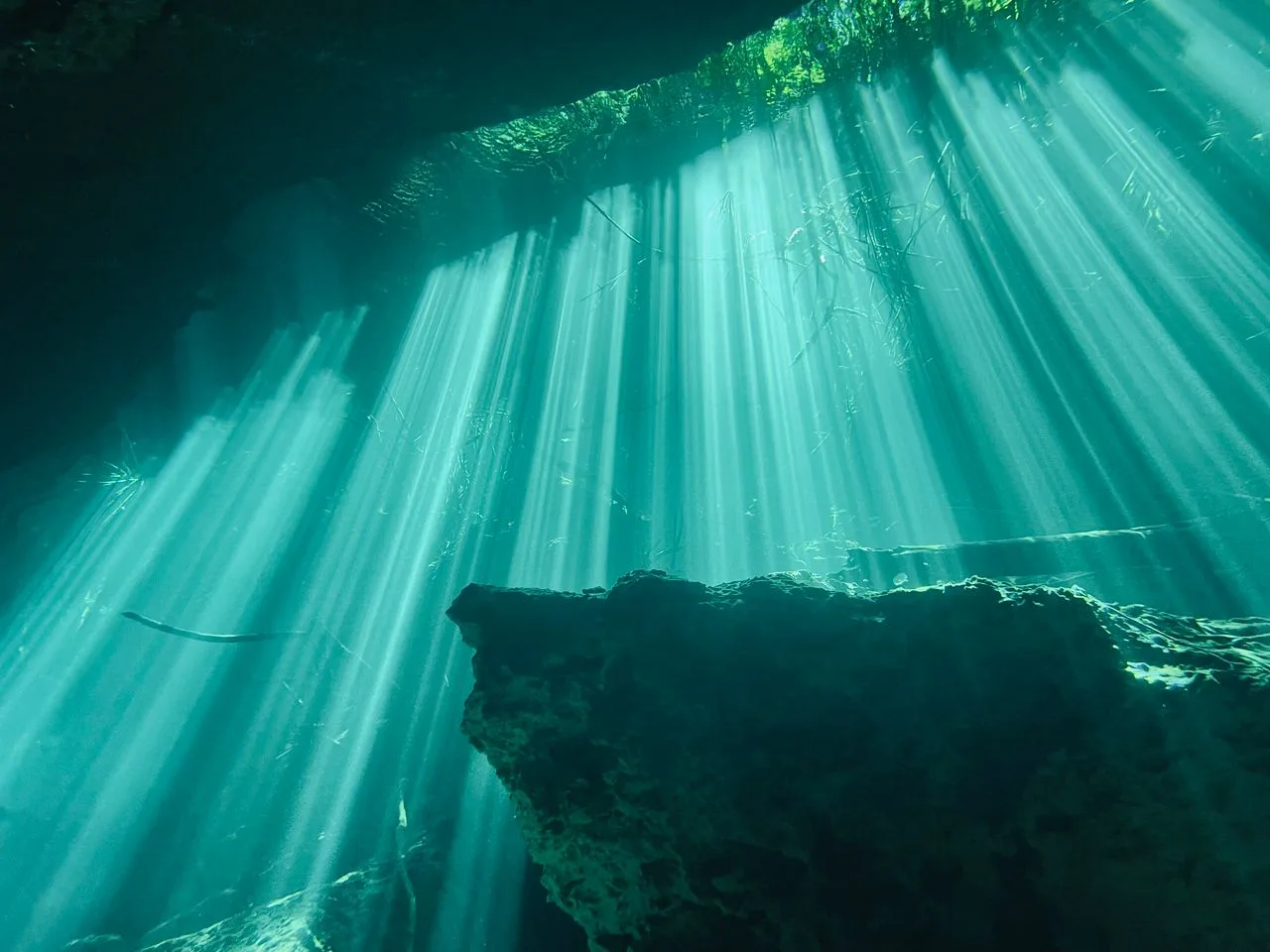
Light beams need three things: a hole in the roof, the sun high enough to shine straight down through it, and a clear sky. That combination is most reliable from May to September, between roughly 11 am and 1 pm. In winter the sun sits lower, so the beams come in at an angle and reach less far into the cavern. Some sites break the pattern, and the light curtain at Kukulkan is a morning effect.
On a cloudy day you still get the formations, the halocline and the full visibility, which are the same in any weather.
The hydrogen sulfide cloud
In deep, open cenotes like Angelita and The Pit, leaves and branches fall in, sink to the halocline and slowly decompose there. The bacteria doing that work produce hydrogen sulfide, which collects in a dense white layer a few meters thick at around 30 meters. From above it looks solid enough to stand on.
Most guided dives hover over the cloud or dip into the top of it briefly. Inside the cloud you can see about as far as your own hand, the water below it is black, and some divers notice a faint taste of sulfur through the regulator. I prefer the view from just above, where the trees and the mound are still visible.
View on Instagram
The view from the safety stop
The last few minutes of a cenote dive are my favorite part of it. The surface of an open cenote, seen from underneath, is often covered in lily pads and fallen leaves, with the jungle canopy visible through the gaps. You hang at three meters in cool, still water and look up at a green ceiling of leaves with sunlight coming through the gaps.
What Lives in the Cenotes, and Why Does the Aquifer Matter?
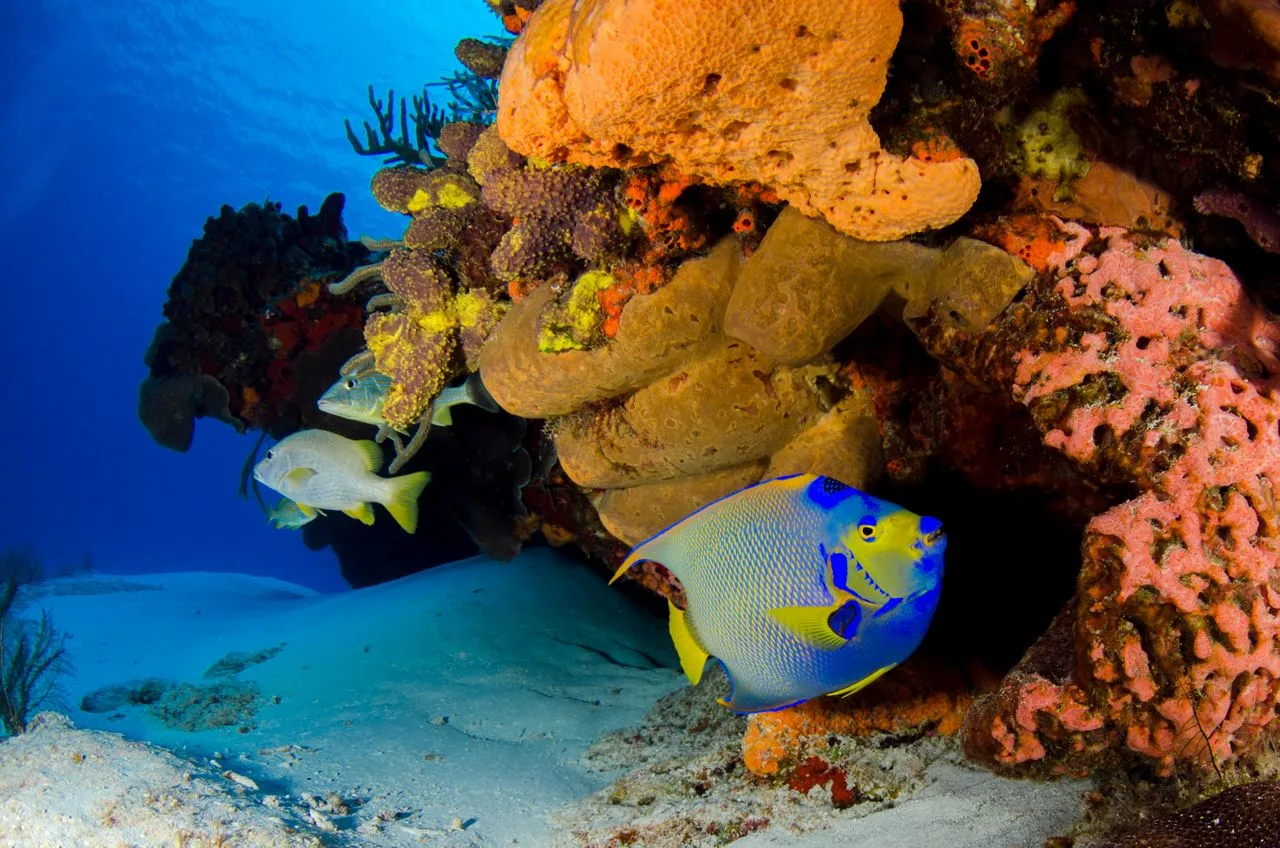
Compared to reef diving, you are trading coral and schooling fish for limestone, light and water clear enough to see 50 meters ahead.
The open pools hold the life. Sunlight feeds algae and lilies, and around them you find mollies, tetras, small cichlids, pale catfish and freshwater turtles. Cenotes connected to the sea, like Casa Cenote, add tarpon and the odd crab. Deeper in the dark zone the residents are cave specialists: white shrimp, and a blind, colorless fish that lives beyond the reach of daylight.
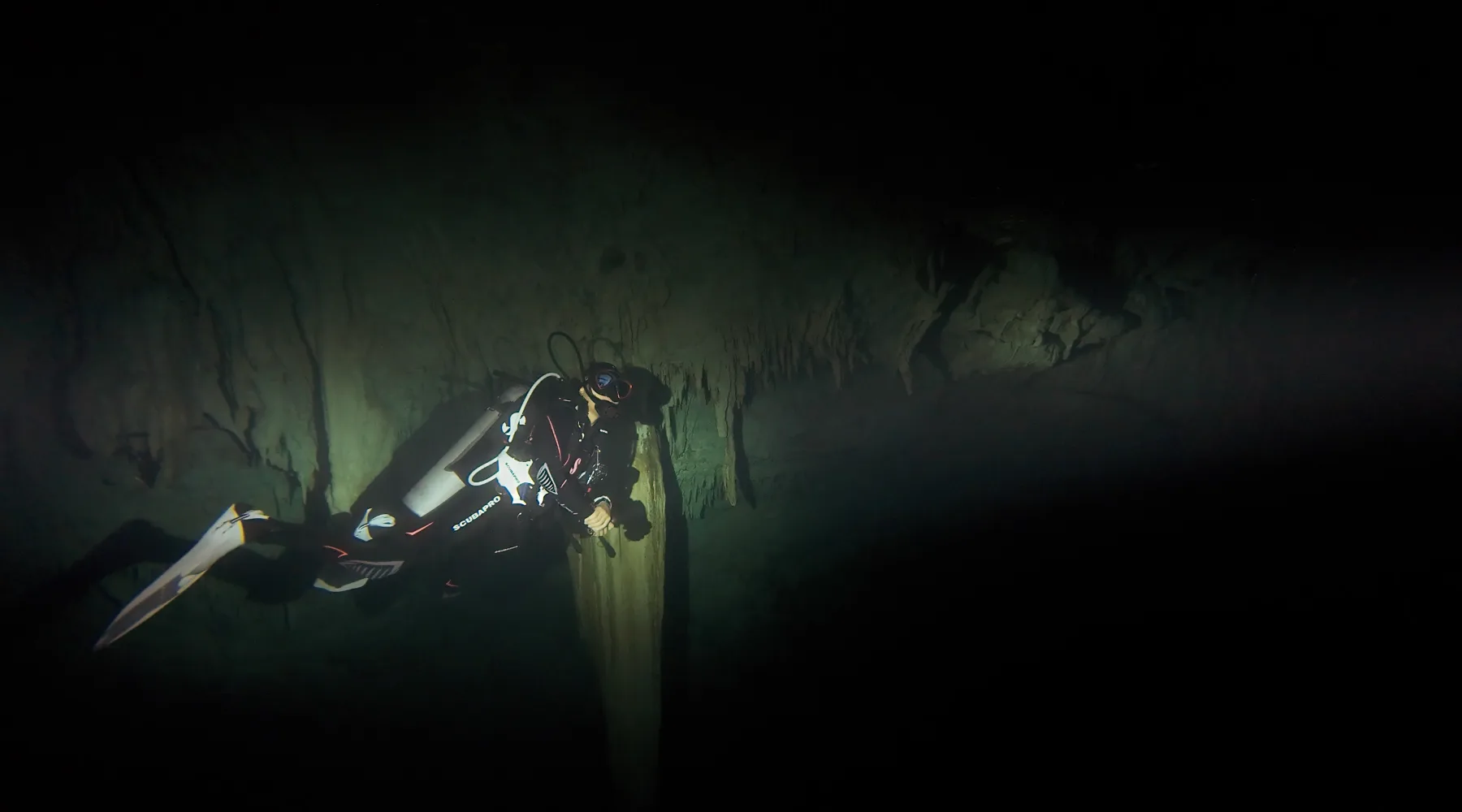
The main subject is the rock. The stalactites, stalagmites and columns formed drop by drop when these caves were dry, during ice ages when the sea was more than a hundred meters lower than it is today. When the ice melted and the sea rose, the caves flooded and the formations stopped growing. That detail changes how you move around them. A formation broken by a fin or a tank valve stays broken, because the conditions that made it ended thousands of years ago.
The flooding also sealed in a record of everything that had walked into the caves. In a pit called Hoyo Negro, inside the Sac Actun system, cave divers found the skeleton of a teenage girl who died roughly 13,000 years ago, alongside the bones of giant ground sloths, gomphotheres and saber-toothed cats. Researchers named her Naia, and she is one of the oldest and most complete human skeletons found in the Americas. Other cenotes hold Maya pottery and offerings. All of it is protected by Mexico’s National Institute of Anthropology and History, so divers look and leave everything where it lies.
One aquifer under everything
The cenotes are windows into a single connected body of water. The two longest underwater cave systems on Earth run under the Tulum area: Ox Bel Ha, with more than 540 kilometers of surveyed passage, and Sac Actun, with around 380. The Yucatán has almost no surface rivers, so this aquifer is the drinking water for millions of people, and it drains out to sea along the Mesoamerican Reef.
The aquifer is under pressure from the surface. The region has grown faster than its sewage systems, and in porous limestone whatever goes into the ground reaches the water table quickly. The Tren Maya railway, finished in 2024, was built on thousands of steel and concrete pillars drilled through the rock, and Mexico’s own environment ministry later acknowledged that more than a hundred caves and cenotes had been pierced during construction. Divers who know these systems have been documenting rust and concrete in passages that were clean a few years ago.
Visitors add to the load too. The popular cenotes receive more than a hundred people a day, and each one brings sunscreen, repellent and hair products into water that moves very slowly. The rules at the entrance exist for that reason, and the same thinking applies as on any reef. I wrote more about it in how to be a good ocean tourist.
The water you dive in is on its way to the sea, where it feeds the same reef you might dive off Playa del Carmen or Cozumel. Our ocean is our responsibility, and on this coast that responsibility starts a few kilometers inland.
Who Is Cenote Diving For?
Cenote diving is for divers who love light, rock and stillness. Compared to a reef, you are swapping turtles and schooling fish for cathedral-sized rooms, sunbeams and total quiet, which is why photographers and slow, precise divers tend to fall for it. It suits divers who can hold a position without sculling, who stay calm with a ceiling above them, and who are happy following a line and a guide without improvising.
A quick self-check helps before you book. You are ready for the shallow caverns if you can hover at five meters for a minute without moving your hands, clear your mask in mid-water without changing depth, and swim with your fins above your body line. A frog kick is a big advantage, because a flutter kick pushes water down onto the silt even from a couple of meters above it.
If you are still working on your trim, have been out of the water for a year or two, or feel uneasy when the surface is out of reach, start the trip with a few reef dives. Then ask your guide for an easy cenote like Casa Cenote first, so you can both see how you get on.
People often ask about claustrophobia. The cavern routes are big, with rooms the size of a hall and daylight visible behind you, and many divers who expected to feel enclosed come out surprised by how open it felt. If tight spaces worry you, tell your guide and start at Casa Cenote or Kukulkan, where the sky is rarely out of view.
How to Plan a Cenote Diving Trip: Bases, Costs, Season and Gear
Where to base yourself
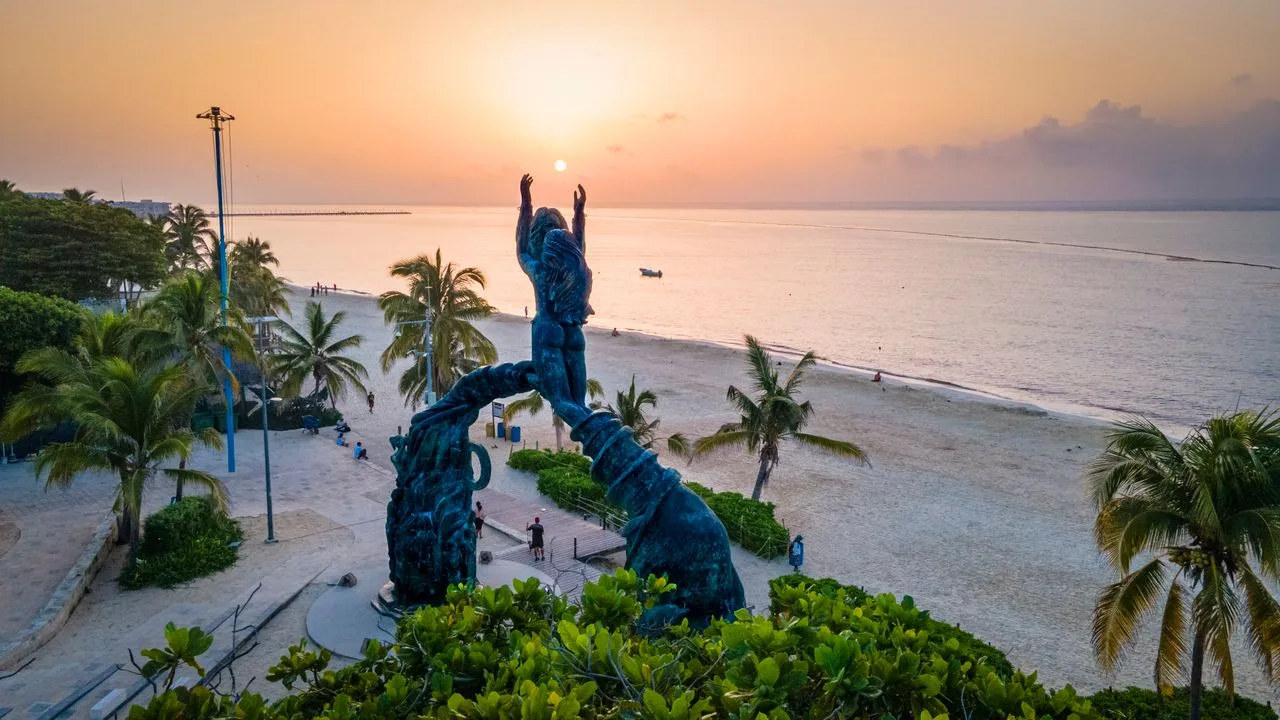
Playa del Carmen and Tulum are the two bases, about an hour apart on the same highway.
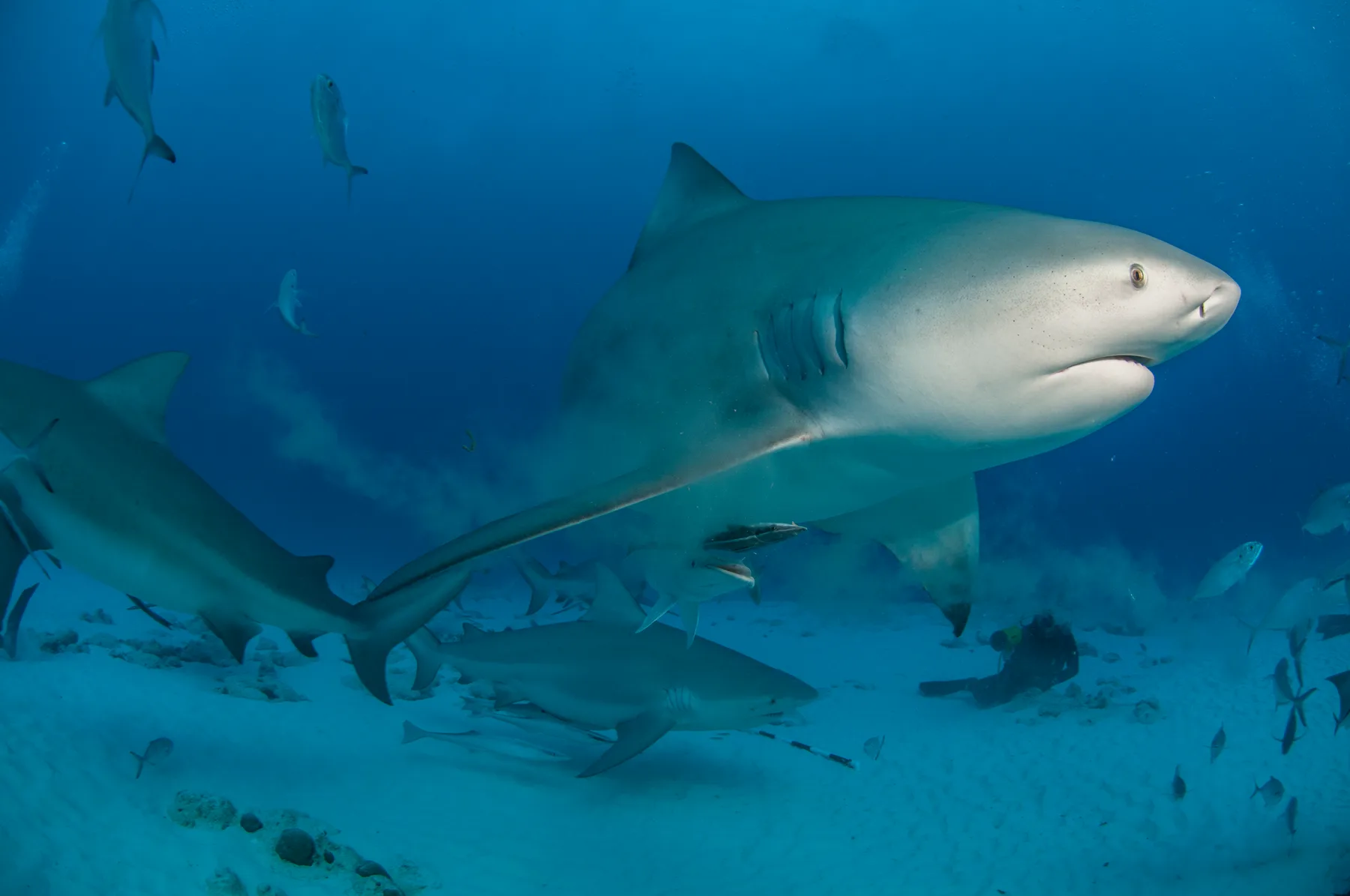
Playa del Carmen has the most dive shops, the ferry to Cozumel and the bull sharks in winter, with Chac Mool, Kukulkan and Tajma Ha under half an hour away. It is the better base if you want reef and cenotes in the same week, and I covered the ocean side in my guide to diving Playa del Carmen.
Tulum is closer to the largest group of cenotes, including Dos Ojos, The Pit, Carwash, Angelita, Casa Cenote and Dreamgate, most of them 10 to 25 minutes from town. It is the center of cave diving on this coast, so the guides there tend to spend their whole working week underground. Choose Tulum if the cenotes are the main reason for the trip.
Most visitors fly into Cancún, about an hour north of Playa del Carmen and close to two hours from Tulum. Tulum also has its own international airport, around 40 minutes from town. Dive shops normally collect you from your accommodation, so the diving itself works fine without a rental car.
How many days, and in what order
Three cenote days cover the classics without rushing, and this is the order that makes sense for most divers:
- Day one in Dos Ojos, or Chac Mool and Kukulkan. Both are shallow, bright and forgiving, and they let your guide see how you dive.
- Day two in Tajma Ha, or Carwash paired with Casa Cenote, for the halocline and the light.
- Day three at The Pit or Angelita if you hold Advanced Open Water, with the deep dive first and a shallow cenote second.
Put one or two ocean dives before the first cenote day if you have not dived for a while. Many divers split the week with diving Cozumel, which is a ferry ride from Playa del Carmen. If you come between November and March, you can add diving with bull sharks in Playa del Carmen to the same trip.
How much does it cost to scuba dive cenotes in Mexico?
A guided two-tank cenote day costs roughly 150 to 250 US dollars per diver, usually quoted in pesos. The shallow caverns sit at the lower end, and The Pit and Angelita at the upper end. The price normally covers the guide, tanks, weights, transport and a torch. Check whether it also covers the cenote entrance fee, which runs from about 250 to 600 pesos per cenote and is usually paid in cash.
Underwater photographers need to budget for one more cost. Most cenotes charge a camera fee at the entrance, and the staff sort cameras into two groups. An action camera is often free or costs 100 to 250 pesos. Anything larger, including a compact camera in a housing, is treated as professional photography equipment and charged at a higher rate, commonly 300 to 500 pesos per cenote. The fee is paid in cash at each site, so a two-cenote day with a full camera rig can add 1,000 pesos to the bill. A few cenotes do not allow cameras at all. Ask your operator for the current rules at each site before you decide which camera to carry.
The four-diver limit means cenote days cost more than a reef boat, and it is the main thing you are paying for. Be cautious of any price that only works with a bigger group.
When to go
The cenotes dive all year. The water stays at 24 to 25°C in every season, and visibility of 50 meters or more is normal because nothing stirs it.
The choice of month comes down to what else you want. May to September gives the strongest light beams and is also the hot, wet half of the year, with the hurricane season running from June to November. Heavy rain can wash tannins into the surface layer of some cenotes for a few days. November to April is drier and more comfortable on land, busier from Christmas to Easter, and it overlaps with the bull shark season on the coast.
The cenotes are also the backup plan for the whole region. When wind closes the port and the reef boats cannot leave, the cenotes are as calm as ever.
What to bring and what to leave behind
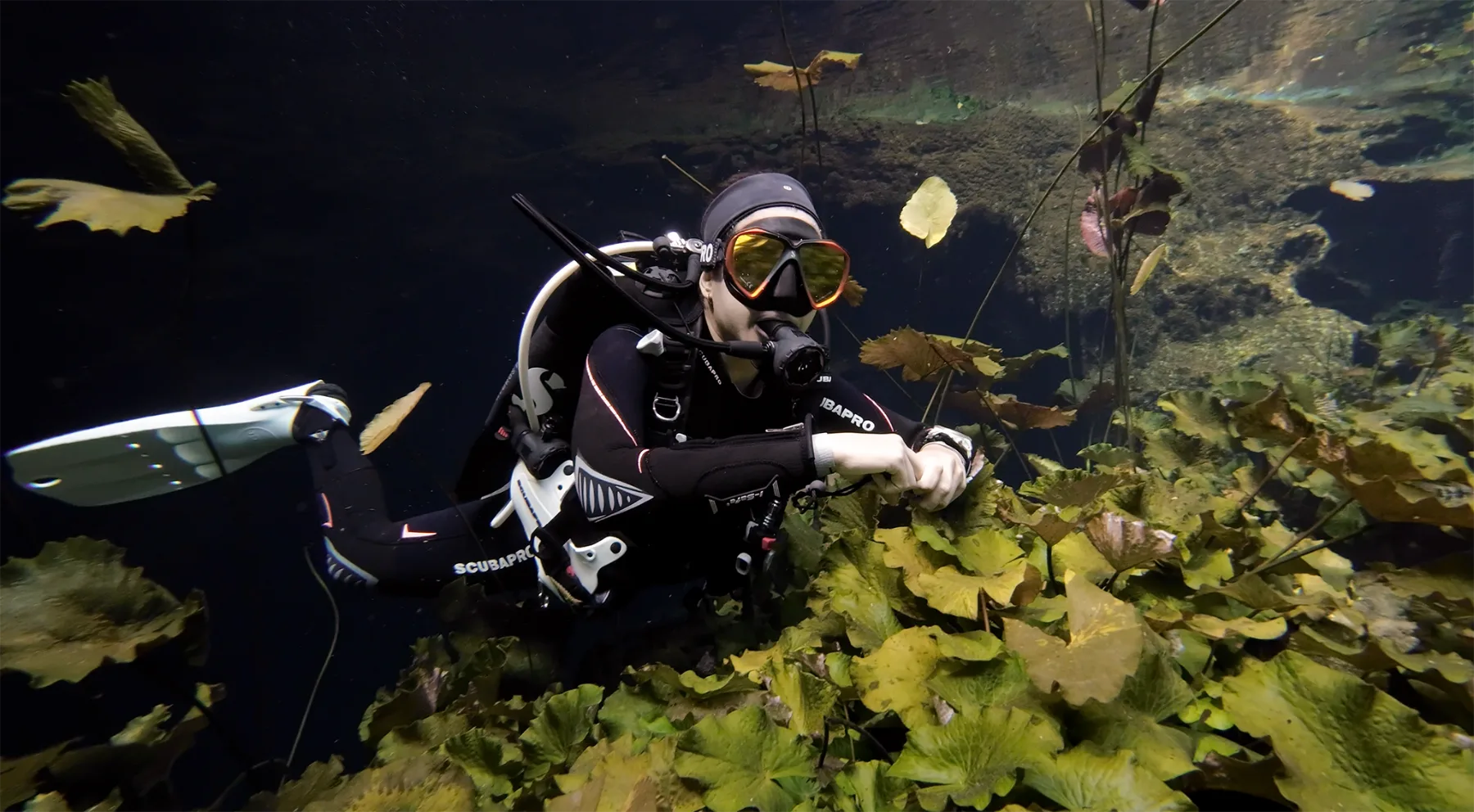
- Wetsuit. Two dives of 45 minutes or more at 24°C, moving slowly, get cold. A 5 mm full suit is the standard choice, and a hooded vest helps if you chill easily. My guide on how to choose a scuba diving wetsuit covers thickness and fit in more detail.
- Weights. Fresh water is less buoyant than the sea, so you need less lead. Expect to drop around two kilograms compared with the same suit in the ocean, and do a proper weight check on the first dive.
- Torch. Your guide will usually supply a primary light. Bringing your own small backup is a good habit, and I explain what to look for in how to choose a dive torch.
- Streamlining. Clip your gauges and octopus close to your body so that nothing hangs below you.
- Sunscreen, repellent and lotion. Leave them off on cenote days. Every cenote asks you to shower before entering, and the staff check. The chemistry behind that rule is the same one I describe in what sunscreen does to coral. A long-sleeved shirt and long pants deal with the mosquitoes in the parking lot.
- Camera. A wide lens and a steady hover matter more than strobes. If you’re a beginner diver, do the first dive without the camera so that buoyancy has your full attention, and check the camera fees above before you pack a housing.
- Flying. The usual rules apply, so leave at least 18 to 24 hours between your last dive and your flight.
How to choose a cenote guide
Ask three questions before you pay. Is the guide full cave certified, and with which agency? How many divers will be in the group? Which cenote do they suggest for your experience, and why? A good operator answers all three without hesitation and asks you about your last dive in return. If an operator offers The Pit to a new Open Water diver, or cannot tell you who the guide will be, keep looking.
Once the planning is done, the diving itself is simple. Go slowly, stay close to your guide, and on every dive take a moment to stop finning and look around at the light and the rock. These caverns took thousands of years to form, and you get to float through them for an hour at a time. Enjoy every minute of it, and tell me which cenote was your favorite when you are back on the surface.